Creencia religiosa
La clase empieza donde quedó la anterior, en la esquizofrenia, y se queda con su versión leve: la personalidad esquizotípica, que no se considera enfermedad y que se pone en relación con el chamán y con el «medio loco» de las sociedades tradicionales. De ahí pasa al ritual, cuya lista coincide con la de las compulsiones del trastorno obsesivo-compulsivo, al cuerpo como prueba de fe y a la tendencia a ver intención y patrón en el azar. Cierra en las hipótesis sobre la ecología, el grupo y la evolución, con la parte genética sin cerrar. La clase avisa de entrada: no sostiene que creer sea sospechoso.
31 · Biología del comportamiento religioso
Refugio, ritual y azar: la creencia religiosa
La esquizotipia y el chamán, el ritualismo que comparte con el TOC y la necesidad de explicación.
La clase en un minuto
- La clase avisa de entrada: no dice que creer sea psiquiátricamente sospechoso, y estudia la biología de la falta de fe con la misma vara.
- El estudio danés de adopción fue la primera prueba clamorosa de un componente genético de la esquizofrenia.
- Entre los parientes aparece una versión leve, la personalidad esquizotípica: percepciones raras, retraimiento y pensamiento metamágico. No es una enfermedad mental.
- Radin llamó «medio loco» al personaje que en las sociedades tradicionales acaba siendo el chamán.
- Kroeber añade el límite: se recompensan solo las psicopatologías leves y transitorias, y sobra quien cree las 24 horas que es un árbol.
- La lista de los rituales religiosos más comunes coincide, en orden, con la de las compulsiones del TOC: limpieza, comida, entrar y salir, numerología.
- Freud llamó a la religión una neurosis obsesiva universal; Ignacio de Loyola y Lutero advirtieron contra el rito hecho por el rito mismo.
- El cuerpo se usa como prueba de fe, y la anorexia sagrada está documentada en Catalina de Siena.
- Vemos patrones en el azar, y más bajo estrés o con un cebado religioso; las palomas de Skinner hacen lo mismo que nosotros.
- El dios que vigila aparece con las sociedades anónimas; la clase cierra en la selección de grupo y deja la genética como hipótesis.
De la esquizofrenia a la esquizotipia
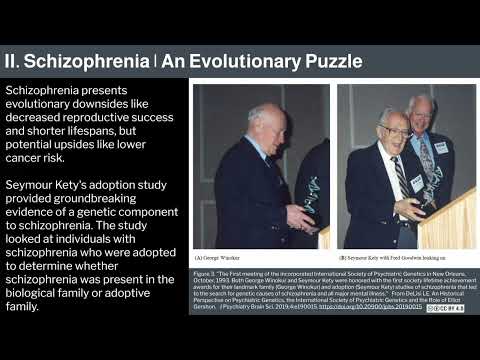
El estudio danés de adopción buscó esquizofrenia en la familia biológica y en la adoptiva de casi todos los casos del país: primera prueba clamorosa de un componente genético. Entre los parientes apareció, a tasa superior a la esperada, un perfil leve —percepciones raras, retraimiento, lectura literalista y pensamiento metamágico—, la personalidad esquizotípica, que la clase no considera enfermedad.
Paul Radin llamó «medio loco» al personaje que en las sociedades tradicionales acaba siendo chamán. Los «locos curados» están documentados en Ackerknecht. Kroeber puso el marco en su ensayo de 1940: ese perfil no solo encuentra refugio, sino sanción. Su salvedad es la clave: solo se recompensan las psicopatologías leves y transitorias. La clase lo titula «Sanción o santuario», y el título real es Psychosis or Social Sanction. De ahí sale, como hipótesis, que el rasgo se mantenga por la ventaja de su versión parcial.
La irracionalidad no se ha desterrado
Ackerknecht sostenía que no se puede separar la tradición occidental de las indígenas por su irracionalidad. La clase afirma que se indignaba con la palabra «primitivos» y que la distinción no se aguanta, y lo ilustra con una encuesta sobre estadounidenses: 25 % cree en fantasmas, 36 % en telepatía, 47 % en ovnis. Esa fuente no se nombra y las cifras no las hemos podido localizar.
El ritualismo, del TOC a la religión
Las compulsiones del TOC siguen un orden estable: limpieza, comida y su pureza, entrar y salir de lugares significativos, numerología. El mismo orden aparece en el ritualismo de las grandes religiones que la clase recorre. Rapoport describió el TOC como el perro que da vueltas a la manta y no puede parar; Freud, como una religiosidad individual frente a la religión como neurosis obsesiva universal.
El cuerpo como prueba
Las religiones también ponen al cuerpo a examinar la fe: ayunos, flagelación y mutilaciones que en otro contexto se leerían como signo psiquiátrico. El caso mejor documentado y más conocido es el de Catalina de Siena.
Ver intención donde no la hay
Buscamos causalidad y agencia, y más en los apuros: quien se declara más religioso ve más patrones en el azar. El estudio que la clase sí atribuye es el de Skinner con las palomas, comida al azar y un ave que repite el gesto anterior. El paso de ahí a los dioses que atienden peticiones es inferencia de la clase.
Dioses, lóbulos y genes
El Dios incognoscible que describe el libro que la clase cita deja al creyente rellenar el hueco; el ejemplo son los estudios con adultos autistas: «son religiosos más o menos a la misma tasa que los neurotípicos». El trabajo de Caldwell-Harris informa de más no creencia entre adultos autistas de alto funcionamiento, y del Dios «que se encarga del magnetismo y de la gravedad» no hay rastro en las fuentes. Un estudio con veteranos con lesiones cerebrales halló más experiencias místicas cuando el daño toca la corteza prefrontal dorsolateral, en el perfil de lóbulo temporal de Geschwind la escritura compulsiva suele versar sobre filosofía religiosa: lo cuenta Lying Awake. Sobre el artículo que atribuye a San Pablo epilepsia del lóbulo temporal la clase se cubre sola.
Ecología, grupo y evolución
Desiertos monoteístas, selvas politeístas; más pobreza y más enfermedad, más religiosidad. Los «dioses grandes» de Norenzayan aparecen cuando la sociedad permite interactuar de forma anónima. Para el individuo, la religiosidad se asocia a mejor salud, descontando dos confusores: menos abuso de sustancias y una comunidad de apoyo. A nivel de grupo, la clase cierra con la selección multinivel de David Sloan Wilson y su calvinismo de los cantones suizos. De genética concreta, nada: un fenotipo emergente.
Quiénes salen en esta clase
La esquizofrenia y la esquizotipia
- Seymour S. Kety (1915-2000) — Psiquiatra y neurocientífico estadounidense, primer director científico del programa intramural del NIMH y responsable de los estudios daneses de adopción en la esquizofrenia. La clase lo cita por tercera vez en el curso. Trabajo de 1968
- Paul Radin (1883-1959) — Antropólogo y folklorista estadounidense de origen polaco, discípulo de Franz Boas, con trabajo de campo entre los winnebago (ho-chunk). Es quien llamó «medio loco» al personaje que acaba siendo chamán. Wikipedia
- Georges Devereux (1908-1985) — Etnólogo y psicoanalista húngaro-francés, considerado fundador de la etnopsiquiatría; escribió sobre el chamanismo mohave y sobre el chamán como neurótico. La clase le atribuye la frase de los «locos curados», que está documentada en Ackerknecht. Wikipedia
- Erwin H. Ackerknecht (1906-1988) — Médico e historiador de la medicina alemán, trotskista destacado en la Alemania de los años treinta, exiliado en 1933; estudió etnografía en París con Mauss y Lévy-Bruhl y escribió el trabajo de 1943 sobre la medicina llamada primitiva. La clase lo llama «Hackerneck» y lo sitúa entre los antropólogos más izquierdistas del periodo. Wikipedia
- Alfred L. Kroeber (1876-1960) — Antropólogo cultural estadounidense, primer catedrático de antropología de la Universidad de California en Berkeley, con trabajo de campo entre los indígenas de California y de las llanuras. Autor del ensayo de 1940 sobre la sanción social de lo que la psiquiatría occidental llama psicosis. Ensayo de 1940
Casos extremos y psiquiatría clínica
- Charles Manson (1934-2017) — Líder de secta estadounidense condenado por los crímenes de su familia; a lo largo de décadas de reclusión recibió diagnósticos que van del trastorno de personalidad a la esquizofrenia. La clase lo trae como ejemplo de religiosidad que se va de las manos. National Psychologist
- Jim Jones (1931-1978) — Fundador estadounidense del Templo del Pueblo, responsable del suicidio colectivo de Jonestown (Guyana, 1978), con 918 muertos. Tenía documentado un consumo intenso de anfetaminas y barbitúricos, y la clase afirma que fue diagnosticado de psicosis anfetamínica. Archivo de Jonestown, SDSU
- Judith L. Rapoport (1933-) — Psiquiatra estadounidense, jefa de la rama de psiquiatría infantil del NIMH, autora de The Boy Who Couldn't Stop Washing, el libro de casos que popularizó el TOC como trastorno biológico. Wikipedia
- Norman Geschwind (1926-1984) — Neurólogo conductual estadounidense de la Facultad de Medicina de Harvard, fundador de la neurología conductual; describió el perfil interictal de la epilepsia del lóbulo temporal. Wikipedia
- B. F. Skinner (1904-1990) — Psicólogo conductista estadounidense, autor del experimento de las palomas supersticiosas de 1948. Trabajo de 1948
La religión y sus figuras históricas
- Sigmund Freud (1856-1939) — Fundador del psicoanálisis; en «Obsessive Actions and Religious Practices» (1907) comparó la neurosis obsesiva con el ritual religioso. Internet Encyclopedia of Philosophy
- Ignacio de Loyola (1491-1556) — Fundador de la Compañía de Jesús. Los Ejercicios espirituales incluyen reglas sobre los escrúpulos y sus cartas advierten contra la escrupulosidad inmotivada. La clase lo sitúa en el siglo XV; sus escritos sobre esto son del XVI. Portal jesuita, Boston College
- Martín Lutero (1483-1546) — Teólogo alemán y padre de la Reforma; fraile agustino en Erfurt desde 1505, tras un voto hecho durante una tormenta. La clase lo presenta como caso de ritualidad obsesiva, con la confesión interminable y la primera misa de cuatro horas. Wikipedia
- Catalina de Siena (1347-1380) — Terciaria dominica y mística italiana, canonizada en 1461; el caso mejor documentado de anorexia sagrada. Wikipedia
- Jesús de Nazaret y Satanás — El episodio de la tentación, en Mateo 4 y Lucas 4: el diablo pone a Jesús en el pináculo del templo y le reta a tirarse para demostrar que es el Hijo de Dios. La clase lo usa para argumentar que la religión necesita una fe que no se pueda demostrar. Mateo 4
Genética, evolución y religión
- Jerry A. Coyne (1949-) — Biólogo evolutivo estadounidense, profesor emérito de la Universidad de Chicago, autor de Faith Versus Fact. La cita que la clase lee —en la ciencia la fe es un vicio, en la religión una virtud— es suya. Newsweek
- Ara Norenzayan (1970-) — Psicólogo de la Universidad de Columbia Británica, autor de Big Gods (2013), sobre cómo los dioses moralizadores aparecen con el anonimato y el tamaño de la sociedad. Página del autor
- David Sloan Wilson (1949-) — Biólogo evolutivo estadounidense de la Universidad de Binghamton (SUNY), defensor durante décadas de la selección multinivel y autor de Darwin's Cathedral (2002). University of Chicago Press
- Thomas Cahill (1942-) — Escritor estadounidense de ascendencia irlandesa, autor de The Gifts of the Jews (1998). La clase cita el libro, se equivoca en el título y no recuerda el nombre del autor, al que llama «un historiador irlandés». Reseña en The New York Times
- Auguste Rodin (1840-1917) — Escultor francés; su El Pensador es la imagen que la clase usa para el cebado del pensamiento analítico. El propio Sapolsky duda de la atribución en la grabación, y la atribución es correcta. Britannica
- Bertrand Russell (1872-1970) — Filósofo y matemático británico, autor de Why I Am Not a Christian; su crítica del cristianismo es lo que recita el paciente hipergráfico en el relato de la clase. Britannica
- San Pablo de Tarso (siglo I) — Apóstol cristiano; se ha propuesto de forma retrospectiva un diagnóstico de epilepsia del lóbulo temporal para su visión del camino de Damasco. Revisión en PMC
- Mark Salzman (1959-) — Escritor estadounidense, autor de la novela Lying Awake (2000), sobre una monja carmelita con epilepsia del lóbulo temporal. La clase menciona la novela sin nombrarlo. Ficha de la novela
- Ursula K. Le Guin (1929-2018) — Novelista estadounidense, hija del antropólogo Alfred Kroeber y de la escritora Theodora Kroeber; la clase sugiere que ese origen explica el tinte antropológico de su obra. Página oficial
Leer la clase entera, palabra por palabra
Transcripción automática del vídeo, sin corregir: solo la hemos limpiado de ruido del subtítulo, maquetado en párrafos y puesto los títulos que él mismo va anunciando. Los estudios y las citas se dejan en su inglés original y se pueden pulsar.
Traducción al castellano automática: si un matiz importa, comprueba el original inglés.
Let's get started. As we stumble into our next to last lecture, we are looking at one of our strangest topics, I think, of the course after all these other ones, getting to the biology of religious belief. And right off the bat, just as a warning put up here, along the way we're going to be talking about what some people might find to be some pretty disturbing religious practices, and I fell into that category, so just be forewarned.
Cómo se aborda el tema
And what we're doing here is approaching it just like any other aspect of human behavior. We're going to start off examining the behavior, and then we're just kind of mixing all the buckets together with a little bit of hormones, but a lot of brain stuff. And then, with a semblance of familiar structure, we are going to stagger to genes, ecology, and evolution at the end.
Now, right off the bat, right off the bat, I need to emphasize in talking about the biological bases of religious behavior, we're going to be looking at some of it in the context of certain neuropsychiatric disorders. What am I saying?
I know you'll see, but what I am definitely not saying is that religious belief is psychiatrically suspect, anything like that. And throughout, keep in mind that while looking at all sorts of features of the biology of religious belief, there's just as much biology going on with people who are incapable of religious belief, who have lost it.
And it's simply, there's a whole lot more religious people than non-religious ones. So, we know much more about it. Okay. So we start off with behavior. And right beginning there, we see the absurdity of talking about religious behavior. So much so that we're going to be done with a topic in a mere seconds because of the variability.
It's been estimated there's more than 10,000 different religious traditions that have been invented on this planet, about 6,000 languages. So that gives you a sense of that ratio. So there's all these different forms of religion. And then there's people who are spiritual but not religious. And then surprisingly, there's heterogeneity among people who are atheists, and different ones who are atheists but they're really like whatever apatheists is the term given for it.
All sorts of whether people get to their atheism through intellectual processes or emotional ones, all sorts of subtypes of atheism. So everything we're looking at here is going to be ridiculously smoothed out in terms of this is one of the more variable outposts of human culture. Now, a theme I already said that's going to run through much of this lecture is, in lots of instances, in some thoroughly fascinating ones, religion offers sanctuary to people who otherwise would be peripheralized, troubled, impaired in their daily functioning because of some sort of neuropsychiatric disorder.
Se empieza por la esquizofrenia
And what religion repeatedly does is not only give them sanctuary and protection, but incorporates whatever their problems are into the religious practices. So we start off. The very first one takes us back to our last lecture, what we were left with at the end, schizophrenia. And at the end, we got to the evolution of schizophrenia.
No other species has anything that looks like it. And are there any downsides to it? Yeah, decreased reproductive success, shortened lifespan. Are there any upsides evolutionarily? Some indication that individuals with schizophrenia have a lower risk of cancer. But what I noted at the end is there may be one major advantage evolutionarily floating around here, and it doesn't have to do with schizophrenia, but something related to it, which takes us back to this whole world of medical genetics where a full-blown version of some sort of genetic disorder is a disaster: homozygotic.
And a partial version, heterozygotic, is actually advantageous. And the textbook example, sickle cell anemia: full-blown version, blood disease that is a disaster; partial resistance to malaria, a whole bunch of these. And there's a possibility that schizophrenia and its evolution can be thought of in that context. Now, this goes back to that classic work by Seymour Kety, trotting this out the third time, though.
El estudio danés de adopción
This was the Danish adoption study that they did with every case in Denmark, or whatever Scandinavian country they wound up in, looking at whether there was or whether there was or wasn't schizophrenia and the adoptive family and the biological, and we know this whole thing. And the number nine was the first screaming evidence of a genetic component to schizophrenia.
All you've gotten from your biological mother is genes. We know that's not really the case, but nonetheless, this being a whopping big vote for a biological component to it. Okay. So, how did they carry out that study?
That took them years to do. Kety and a small team of researchers went over there and they went through, as I've said, every single adoption case that existed in the country at that time, being able to access records of who were the biological parents, adoptive parents, and spent years interviewing all these people, interviewing biological relatives of individuals with schizophrenia, adoptive relatives.
And in the process, they had done something unique. Take your average, I don't know, psychiatrist who works with people with schizophrenia, and I don't know, 10 patients, 20, whatever over the course of the year. If they're young, a couple of times a year you'll meet with their parents for a progress report. And what these guys had done instead was, in the process of doing this for years and years, they had just talked to more relatives of people with schizophrenia than anybody had ever done before, because they were going through hundreds, thousands of cases.
They just had the largest exposure to close relatives of people with schizophrenia ever. And they noticed something interesting. They noticed that not every single family member of somebody with schizophrenia, absolutely nothing remotely like that. But at a higher than expected rate, a lot of these relatives were like a little bit weird, a little bit off.
La personalidad esquizotípica
People could be a little bit off in the exact same way and not have a close relative with schizophrenia. Not every relative of people with schizophrenia shows this profile, but at a way, way higher than expected rate, some sort of odd features. And when you look at them, they wind up being kind of a mild version of schizophrenia, what has come to be called schizotypal personality.
And people debate whether it should be called schizotypal personality or schizotypal personality disorder. Is this a disorder? Is this a quirk? Is this an idiosyncrasy? It's people who are perfectly normal but are kind of odd in a number of fairly consistent ways. Odd perceptions. They will report feeling a presence of someone in the room when they're in an empty room, things of that sort.
Social withdrawal, very socially disconnected. Two classic professions of schizotypal individuals: one is you're up on top of a fire tower watching over mountains looking for forest fires, and you're by yourself 24/7. Or you go into a movie theater, and in the back there, there's the person running the film, or whatever, who sits there in the dark all day, tending towards occupations that were extremely solitary.
Social withdrawal, mild concreteness, concreteness along the lines of domains that most of us would see as parables, uh, metaphorical, whatever, they take literally. For example, just to show you where we're heading, very literalist, concrete interpretations of the Bible. The world really was made in seven days. It is really possible for someone to have walked on water, to have turned blood into wine, whatever it is that went on, that these were not just instructive metaphors, parables, but quite literal.
Mild concreteness along those lines. Finally, the really interesting one is what came to be termed metamagical thinking: just being really interested in like, you know, kind of borderline suspect stuff like horoscopes or extrasensory perception or UFOs, or people who were really, really, really into their science fiction, fantasy, whatevers, and cosplay, and go off to these Star Trek conventions, and all of those.
This is not a mental illness. Going to a Star Trek convention is not a sign of a mental illness, nor any of these. It's just sort of an odd, quirky personality that has some resemblances to schizophrenia, but a milder version of all of these, and thus termed schizotypal personality. So looking at this, the question becomes, who are individuals who were schizotypal?
Paul Radin y el «medio loco»
And it turns out almost a hundred years ago, an anthropologist named Paul Radin gave what I find to be very convincingly the answer to that question. Radin studied northwest Native American populations and wrote various dictionaries and stuff, and like a very accomplished anthropologist. And Radin at the time began to talk about how in lots and lots of traditional societies, indigenous cultures, there would be an individual who he would call "half crazy." Half crazy.
Who was he talking about? Shamans. This made perfect sense. In lots of cultures, shamanism is about tricksterism, things of that sort, sleight of hand, and things like that. But in lots and lots of cultures, what are shamans?
They go into trances. They talk to the dead. They turn themselves into a hyena during the full moon. They sojourn alone, living for days and days in the desert, and then come back with the good word, things of that sort. Shamans in culture after culture are shot through with metamagical beliefs and actions and often social withdrawal.
Devereux y los locos curados
And what you see there is shamanism has been around forever. And there's been this whole thread of anthropologists noting this. One anthropologist, George Devereux, talking about shamans as being healed madmen. Another anthropologist, Devereux. This was mostly in the 1930s and 40s, talking about how religion is organized schizophrenia and schizophrenia is personal religiosity, talking about shamanism as a root of all of this.
And this winds up, for my money at least, and lots of people at the time, making a ton of sense. Now, one of the all-time grand pooh-bahs of anthropology, this guy Alfred Kroeber, had something really interesting to say about this. He was one of the dominant anthropologists of the early part of the 20th century.
Incidentally, anyone who is a science fiction fan and reads and adores Ursula K. Le Guin's writing, Ursula K. for Kroeber, she was the daughter of Alfred Kroeber, which probably explains the very anthropological and zoological tint to a lot of her writing. In any case, Alfred Kroeber, early in the last century, was considering this whole issue of people who were psychiatrically suspect, half madmen, healed madmen, half and associating it with shamanism.
El ensayo de Kroeber
And he wrote a really interesting essay called "Sanction or Sanctuary," where the whole point of it is, in culture after culture, as we heard last week, people who are mentally ill, people with schizophrenia, are peripheralized, are out-grouped, or mistreated, or persecuted, or all of that, including people with milder versions. And he's emphasizing that in lots of indigenous religions, not only is religiosity there a place of sanctuary for individuals with a personality profile like this, but in fact is sanctioned.
It is celebrated. Amid people with schizophrenia having a decreased reproductive success, in culture after culture, shamans are proclaimed. Shamans are powerful members of society. Shamans often have very elevated reproductive success rates, all of that. So this argument all along, saying this is a traditional role filled by people with schizotypal personalities. Now, Kroeber made this very, very clear distinction, which comes down to, for example, this quote: "In general, the psychopathologies that get rewarded among primitives are only the mild and transient ones." And he at one point said, "Yes, yes, uh, you know, it's great having shamans, but society is ill-served by somebody who 24/7 believes that he is a tree." And a great example of this, Kroeber mostly studied North Plains Native Americans.
And he was at one ceremony once, and with the sort of informant there, and watching it, and it was this shamanistic ceremony, and the shaman was this frothy, amazing, over-the-top, all sorts of histrionic stuff going on. And at some point, the informant leaned over to Kroeber and said, "Wow, can you believe our shaman?
He's like the best. Nobody does these rituals like he does. He is just over the top with all of that. We are so lucky to have him as our shaman. But thank God we don't have two of them." And what we just saw is cultures could deal with a certain number of individuals like this.
You don't want half the population to be shamans. You want people to speak in tongues during religious rituals. You don't want them to speak in tongues in the middle of the quiet moment of a hunt or something like that. It is partial. It is controlled madness in the terminology they gave there. Kroeber, by stating it in terms of these are people whose psychopathologies are mild and transient, who are hearing voices at the right time, what he just defined was schizotypy, half a century before the word even came to exist.
So you look at that, and what that begins to suggest in traditional human cultures, we've got the same kind of heterozygotic, homozygotic argument that we've seen in other cases. Heterozygotic, you got the shamans. Shamans, like every culture has come up with shamanistic individuals and celebrated their metamagical stuff, and all of that. And if the price is, if the homozygotic price is every now and then you deal with a cousin with what we would call full-blown schizophrenia, the trait is carried along by the adaptiveness of the partial version.
That is the argument that comes out of that for the evolution of schizophrenia. There has not been selection for genes pertinent to schizophrenia; there has been selection for milder versions of those genes with schizotypy. Okay. So what about in the West?
Occidente y la palabra «primitivos»
What about in the West? And you notice we already heard from Kroeber's quote the word "primitive" pop up. Hackerneck in the '30s was probably the most leftist anthropologist of this whole time period, which is to say he was not a flaming racist, unlike sort of the backbone of anthropology then. Hackerneck was outraged at words like "primitives" and things of that sort, and saying like, "How dare we, how dare we, sort of, uh, you know, be offensive about their religions, and traditional cultures, saying that they are mired in the irrational." No, they're not irrational.
They're serving a purpose for them, all of that. And his argument was, you can't make that distinction between Western culture and indigenous traditional ones. And my view is you can't make that distinction either, but for a different reason. Yeah, traditional cultures, shamanism, and their religions are totally irrational. And religiosity in the West is totally irrational as well.
And we will see sort of the formal definitions of that, of how it fits. It's been sort of people at the time saying our culture is unique in having banished irrationality. That might be a little bit over-optimistic there. Here are some recent statistics from a poll looking at Americans, American adults, American adults who are allowed to vote and drive motor vehicles, and things of that sort.
And what did this recent poll show? 25% of Americans say that they believe in ghosts. 36% believe in mental telepathy. You can project your thoughts into somebody else, or pick them up. 47% believe that not only are there alien life forms out there, but they have visited us, and there are UFOs. And more than half of Americans believe that the devil is not a metaphor, that the devil is a literal being in some version of flesh and blood.
We have not banished the irrational in Westernized cultures. We have instead celebrated it forever. In some cases, the metamagical irrationality of the West is fairly recent. This is like some new age, "nouveau peasant" belief stuff with hot tubs, or who knows, things like that. But in lots of cases, instead of this fast-food spirituality, it is metamagical thinking that is stretched back for centuries, for thousands of years, have legacies all throughout our history.
And the West has been mired in metamagical thinking, in the form of Western religions. And just to put that sort of in perspective, it is not normally a sign of robust good mental health to report that you hear a voice coming out of a burning bush. To report that you just spent the night wrestling with an angel.
To report that you just had a conversation with someone who died a few days ago, and you encountered them walking around. Where did these notions come from? Where did the idea come that the world was made in seven days, or that when snakes are talking to you about apples, be careful because they're up to no good?
These were not made by committees. These were made by schizotypal individuals who were immensely influential and wound up supplying the metamagical thought for their whole culture for centuries, for millennia afterward. Now, of course, this brings us back to Kroeber's point. You don't want somebody who always thinks they're a tree. You don't want somebody who is bursting out in glossolalia in the middle of a quiet part of a hunt.
All that. You want to control it. You want it partial. It is controlled madness in the terminology they gave there. Kroeber, by stating it in terms of these are people whose psychopathologies are mild and transient, who are hearing voices at the right time, what he just defined was schizotypy half a century before the word even came to exist.
So you look at that, and what that begins to suggest in traditional human cultures, we've got the same kind of heterozygotic, homozygotic argument that we've seen in other cases. Heterozygotic, you got the shamans. Shamans, like every culture has come up with shamanistic individuals and celebrated their metamagical stuff, and all of that. And if the price is, if the homozygotic price is every now and then you deal with a cousin with what we would call full-blown schizophrenia, the trait is carried along by the adaptiveness of the partial version.
That is the argument that comes out of that for the evolution of schizophrenia. There has not been selection for genes pertinent to schizophrenia; there has been selection for milder versions of those genes with schizotypy. Okay. For example, Charles Manson was diagnosed with schizophrenia long before he like burst onto the national consciousness in the 1960s.
All of you are way too young to know about him. Another one, Jim Jones, led Jonestown in Guyana. It led to this mass suicide of almost a thousand people with this religious group that he had founded. And he had been diagnosed with amphetamine psychosis. Oh, that takes us back to the schizophrenia lecture.
I left that out. That whole thing, you block dopamine receptors, and schizophrenic symptoms become less. I bet you there was too much dopamine. Dopamine hypothesis: Do the opposite. To take someone who is not schizophrenic and give them a drug that releases excess dopamine, a drug like an amphetamine, and they begin to look psychotic, an amphetamine psychosis.
Somebody comes into an emergency room, and they're tangential and hallucinating and all of that. And if you pump their stomach out and suddenly they start making a whole lot more sense, it was probably amphetamines rather than schizophrenia. Okay, so Jim Jones, diagnosed with amphetamine psychosis, when it is taken too far. These are like disastrous cult movements that are splotched in all sorts of madness.
But get it right. Get it right to the exact perfect extent and do it in the right place and time. Get this schizotypal stuff just perfect to fit what is needed at the time, and with any luck, for millennia afterward, people won't have to go to work on your birthday. So I think what we see here is the beginning of this notion of one domain where religiosity in the form of metamagical thought, metamagical belief, all of that, providing a sanctuary for what otherwise is someone sitting alone in a projector booth.
El armazón conceptual de las religiones
This gives you sanctuary, and it sanctions what you're doing, and it elevates this, and celebrates it in lots of circumstances. So another domain in which this comes through, thinking about sort of what the backbone of religiosity is, and much of it is sort of the, the steel superstructure of religion, is, is the large sort of abstract thoughts as to how you go about deciding: Is there an afterlife?
Is life sinful or otherwise? Is there a purpose to be here? What is our responsibility to all of that? And lots of religions summarize into these sort of conceptual notions: there's the Holy Trinity, "I am that I am," "There's no god but Allah," all of that. So a lot of religiosity is built around that stuff.
In these current times, a lot of religiosity is built around something that is still relatively recent: the notion that religiosity is about community, about pro-sociality, about good acts. But all throughout, there has been another thread going through religious belief of the highly orthodox, highly fundamentalist religious among us, which is the importance above all else of rituals and ritualism.
El trastorno obsesivo-compulsivo
Now, to begin to appreciate that, we look at our next sort of neuropsychiatric disorder, and this is one that like lots of us are familiar with and have elements of or certainly know people with, OCD: Obsessive Compulsive Disorder. Obsessions: thoughts that won't stop. Compulsions: actions you cannot prevent, actions that compel you, that you have to do, and you have to do often in wildly maladaptive ways.
Okay, all of us have elements of this. My guess is most of you are too young to have ever had the experience of going to a mailbox and actually putting a letter in there. Instead, you just like hit send and it goes off. Back in the old days, you'd have something really important, like an application or some checks or something like that, and you go to the mailbox and you like put the letter in the mailbox, and you check to make sure it goes down, because it's important.
And you check again just to make sure that it's not stuck there on something. And you begin to, but it's probably, you know, it couldn't hurt to check once more to see if it really went down. And you start walking away. What if there's a hole in the bottom?
And before you knew it, you're on your knees looking underneath. And we would all do stuff like that. Actually, maybe we didn't all do that, but I certainly would if it was important enough. Just getting caught up in this ritualism of that at a very particular time. Here's another example of this. Okay, here we have two satellite photos.
And this first one, this is a picture of a tray of Rice Krispie Treats. And this is what it looks like after any of us is left alone in a room with that and a small knife. We all cut off this edge and eat that little piece. Why do we do that?
Because we think eating just a little piece doesn't count as cheating on our diets. Or are we thinking it'll be fresher if you minimize the amount of like interface with air? No, it just feels like weird having this little piece sticking out, and you just got to smooth it out. We all have that impulse at that time, and we trim it off.
And this is remarkably common, and this is not a psychiatric disorder, obviously. But then there's the world of people for whom these impulses, these obsessions, these compulsions take over your entire life. To get a sense of what goes on with somebody with full-blown OCD, which falls into a category as destructive to your everyday functioning as a major depression, as schizophrenia, all of that.
What's one of the most common things at the top of the list? Washing, cleansing, purifying yourself. People with serious OCD will spend five, six hours a day washing their hands in rituals, enormously ornate rituals. You first do a cleaning in water of a particular temperature that you have to check with a certain type of soap, and then you can dry your hands with a certain specified towel.
And then you do a second washing at a different temperature, with a different type of soap, then a different type of antibacterial something or other. And you go through this whole sequence, and an hour into it, finally, finally, finally, you are clean. And inevitably, as you're stepping out of the bathroom, your elbow hits the door, and you've just gotten soiled, and you got to go and do it all over again.
People with severe OCD like this cannot hold down jobs because they are gummed up with rituals like these for hours and hours every day. Hours of rituals built around food preparation, about having symmetrical stuff, utensils symmetrical. You can't start on an assignment until your pens and pencils are perfectly parallel with each other.
You are driven to distraction if there is some sort of asymmetry around that you can't fix. And the whole point of these is, this is not just quirks. These are people whose lives are ruined by this disease. And that was a remarkable recognition when people began to, you know, view OCD as a separate psychiatric disorder, that you can have your life destroyed by things seeming so sad you can't get out of bed, or being so thought-disordered and you're hearing voices that you can't put two coherent sentences together.
But your life could also be destroyed by this sense that you got to wash and wash and wash, and it is never enough, and somehow you always get dirty again. When you look at OCD, there is a structure to the compulsions. Number one, as I said, on the list of every culture out there with OCD, way at the top of the list are rituals of personal hygiene: washing, ornate rules about it, ornate sequences, things that you feel soil you and trigger you having to start the process all over again.
Second most common category of compulsions: ones related to food safety, food purity, food purification, food prohibitions, all sorts of things that you do built around that. Third most common: ritualistic compulsions built around when you are entering or leaving a place of significance. You have to have walked a prime number of steps before you could enter the building for a job interview.
That's one of the ones that comes up. You're finally taking a chance on going out and getting a job, and you know, you just know it's not going to work out right if you do anything other than walk a prime number of steps to get to the front of the building. And if you didn't pull that off, or if it felt like you kind of cheated, you got to go do it again and again and again, and you never show up for the interview.
Rituals of entering and leaving places of emotional significance. And number four on the list: numbers, numerology, compulsions about you have to do something a certain number of times before you could pick up the fork. You have to tap it X number of times on the table, things of that sort. And these are the most common compulsions in OCD.
So, how do we make sense of OCD? The person does not have insight. They do not say, "Help me. For some reason, I need to wash my hands six hours a day." They say, "Help me. For some reason, I can't get clean." There is no insight into it in lots of cases. And what you see is, not surprisingly, OCD is categorized in sort of a psychiatry Bible as a subtype of an anxiety disorder.
It's this free-floating, permeating anxiety, dread. Dread of what is menacing all around you. And if you do the rituals just right, if you enter the right number of steps, if you pull this off, if you've been clean enough, if you do, you can hold off the dread. And it always proves to be temporary because it always comes back.
Rapoport y el perro que no para
Psychiatrist Judith Rapoport, who wrote a great book 30 years ago, um, case studies of individuals with OCD, I think the book was called The Boy Who Couldn't Stop Washing, had a metaphor, a metaphor straight out of everything we know about a fixed action pattern. Lots of us recognize the fixed action pattern of when a dog is getting ready to go to sleep.
It goes over to its blanket or its pillow or whatever it is, and it circles around, sort of patting it down. And then it circles around some more, and then it's about to settle, and then it does a little more circling, and then a few more times it maybe once, and then finally settles down.
In Rapoport's view, OCD is the dog circling the blanket who could never, ever stop. It can never, ever feel as if you have kept that dread permanently at a distance. You've only held it off. You've only held off the anxiety for a while. So, where does religiosity come in?
Like, there's all sorts of ways of being great at religion. You could do wonderful works. You could be a religious leader that takes the form of being a military leader at the front of a crusade. All sorts of versions. But then there's a whole world of people who are really good at their religion insofar as they are really good and ornate and devout and orthodox and fundamentalist in the carrying out of rituals.
Cuatro religiones, los mismos rituales
So just to give a sense of it here, we'd have four of these like world religion ones. And what we see, okay, in the first one, if you were going to be in the upper strata of religion, and this particular religion honored all of that, what's involved is you have six hours of handwashing and body washing a day.
There are rules as to the first sight you're supposed to see in the morning, which foot first steps outside in the morning. There are rules about what direction you are facing when you're sitting on the toilet. There are rules when you are doing certain rituals as not only the number of breaths that you take, but the ratio of one nostril that you hold closed and then the other nostril, rituals of the ratios of washing the left hand and the right hand, stuff like that.
There's a magic number. The number 24 is considered magical in this particular religion. There's food prohibitions which could be defined as a food which is absolutely palatable and a totally reasonable source of nutrients, like during a famine, and sacred values that people would starve to death before they would eat this. So a whole bunch of these.
So another one of these religions. What's going on? This one has all sorts of rules. I think washing 12 different times in the day, that there's a whole ritualistic thing that when you enter or leave a place of emotional significance, a gesture you're supposed to make at the doorway. There's food prohibitions out the wazoo.
And in much the same way of sacred values, people will starve to death before they violate these food prohibitions. There's all sorts of magic numbers. There's the magic number 18, which is full of significance. There's a really interesting magic number in this religion: the number 613. What is 613?
Those are the number of rules you are supposed to follow each day in order to be a devout, observant member of this religion. 613. What is that about? And you will notice it consists of two numbers. The first one is the number of days in the year. And at the time that this was first invented, what people thought was the number of bones in the body.
How many rules are there each day to please your deity or deities? Well, it's the number of days of the year plus the number of bones in the body. It happened that these are things, 248 that you have to do, 365 that you have to avoid doing each day, which led one sage to say, "Well, since it is so easy to inadvertently sin more in this domain than that, it's better that we hadn't been born." Here's the evidence that this is about the numerology.
It is about the ritual number rather than the content itself. For centuries, people have been arguing over what are the 365 things you're not supposed to do and what are the 248. The actual content doesn't matter as much as the notion that your deity or deities want you to make sure you avoid doing as many things as there's days in the year and do as many things as there's bones in the body and the numbers for their own sake.
There's ritualistic hand gestures that you see among the elite in this religion where they signal to each other. They display that they are of that upper stratum. Next religion. This one. This one involves, okay. Once again, washing rules about how many mouthfuls of water you take to wash out your mouth and spit it out in the morning.
Sequences of which hand you wash first, followed by which other one. There are rules as to the first food you're supposed to eat each day. There's rules of ritualistic things when you enter or leave a place of significance. There's rules out the wazoo about what you are supposed to do when you are going about your personal hygiene.
Food prohibition, same thing again. Ornate, completely irrational. Taking people who, like in every one of these, has been circumstances where people have been seriously starving. Yet this food prohibition would be way at the top of the list of things you were supposed to stick to, and its own set of magical numbers: 7, 10, and then multiples of both of them.
What else? Now we have another religion, another major one. And there's number of prayers, number of prayers for this occasion, for that occasion, for depending on what you've done, depending on what you haven't done. You are told the number of prayers you need to make. There's ritualistic hand gestures that are made when you enter a place of significance or leave it.
You are supposed to make these gestures. The number three is considered magical. There's all sorts of food prohibitions, and there's all sorts of rituals around eating ritualistic food. What are all of these looking like?
These are all looking like the rituals of obsessive compulsive disorder. These are Hindu Brahmins. These are Orthodox Jews. These are highly observant Muslims. And this is mostly Catholicism with a mixture of some other Christian sort of rituals in there. What do we see in all these cases?
These are exactly the same things as in OCD. You look at the most common religious rituals out there, and they are about cleansing, self-cleansing, and purification. The second most common about food purification, food preparation, food prohibitions. Third most common, ritualistic things you are supposed to do when entering or leaving a place of sanctity.
Fourth, numerology. And these religions, if you are going to be a devout person in any of them, at the highest level of asserted orthodoxy, your life is consumed with this. Six hours a day of washing. All sorts of rules as to how many hours you have to wait after eating one type of food and another.
If you like soil one of your utensils in the process, how many months it needs to be buried in soil to become cleaned, all of that. What we see is it's the same business. It's the same sequence. It's the same hierarchy of ritualism as in OCD. Now, where we're obviously heading is the notion that religious ritual in this case gives sanctuary and sanction for people whose lives might otherwise be completely taken over and destroyed by their pull towards ritualism.
Freud: la religión como neurosis obsesiva
Now, all sorts of people have noted this. People in the secular world. Freud, for example, said that obsessive religiosity is like an organized, no, what was his exact quote? "Obsessional neurosis is an individual religiosity, and religion is a universal obsessional neurosis." Okay, that's saying what religion is about is sharing the rituals. Okay, Freud: snide, dismissive, secular, all of that.
Throughout the centuries, religious leaders have recognized the exact same thing. Um, a sixth century monk who was writing about how prayer doesn't count if you're not concentrating on it. If you're not thinking about it, if you're just doing it by rote, it doesn't count. 15th century Ignatius of Loyola, when he was training new priests, said, "Be on the lookout for people who would be giving their prayers but were showing scrupulosity.
All they were doing was doing the rituals for the ritual's sake." And what you're supposed to take them aside and say, "God doesn't care how many times you say this. God cares that you are thinking about this, that you are feeling it. Be on guard against people who are doing this stuff just out of mindless rote stuff." This is not a mental illness.
What it is, again, is a source of decreasing anxiety. Rather than a nameless dread, the dread gets a name. It gets a name. It is Lucifer. It is some such thing. It gets a name, and it comes with feeding instructions as to how to keep it at bay and how to please your Lord who is going to help you keep it at bay.
And most importantly, it's shared. It's you and the other co-religionists. It's how you collectively keep that anxiety at bay. It's how your ancestors have been doing it for centuries. It's an enormous source of comfort in that regard. You give it a name. You are given very strict rules for how to keep it at bay.
And finally, finally, unlike most people crippled by OCD, you're not alone. You're sharing this stuff. Now, this brings up sort of a second level way of appreciating this. So, who are the great religious leaders?
Vivir del ritual
They can be great thinkers or metamagical, or they could be social revolutionaries, or they can be military leaders, all of that. But what this introduces is there's another way to be a religious leader, which is to be really good at rituals. Because if done right, you can make a living being religiously ritualistic.
In traditional Hindu belief, among Brahmins, there's a prayer, the Gayatri prayer, that you are supposed to say 2,400,000 times in your lifetime, a multiple of this sacred number. And if you are a wealthy Hindu and you're getting on in years and you haven't quite gotten enough of these done yet, you can hire a whole bunch of Hindu priests and they come and you set them up in your backyard with a big tent and you feed them all the time and you hire them to do the 2,400,000 prayers for you.
You can get hired to pray for somebody else in a ritualistic way. In Judaism, you could be a rabbi with kosher law, with orthodoxy, where you sit in a food preparation factory, and you're not preparing food. You have nothing to do with it. Your entire job is to watch to make sure that other people are preparing the food in a ritualistically acceptable way.
You make a living doing that. You make a living in all sorts of... you get priests who come and bless convocations. And you say, "Oh, no, but that's not really their job. I mean, this is part of who they are." And you reflect on it, and in all these cases, these are people who are having jobs.
They're getting health insurance. They're getting retirement accounts or something when they step down from being the rabbi, making sure that like the tofu dogs would bring a pleased smile to the lips of Abraham, or something that is being prepared in the right way in this factory. In all of these, you could make a living at being really good at religious rituals.
Un monje agustino llamado Lutero
And then we begin to get some insight into this remarkable piece, this historical document about this 16th century monk. This monk, he was, what was he? He was an Augustinian monk named Luther. And Luther, by all reports, had had a fairly difficult life. Um, he was known to have had a brutal, terrifying father.
A father who, the records indicate, was arrested on one occasion for having murdered somebody in a fight. A terrifying father. Our Luther grew up anxious, hypochondriac, filled with all sorts of dread. At one point, he was out walking across a meadow and a thunderstorm came up and he had a panic attack, and he at that point prayed to God and said, "If you let me survive this thunderstorm, I will devote the rest of my life to you." And he survived the storm, and he became an Augustinian monk, and he threw himself into it like crazy.
He took vows of silence for days on end. He would repeat the same prayers over and over and over. The first time he led a mass, what was supposed to be, I don't know, half an hour long, it went on for four hours because he kept deciding he had stumbled over a word or he had said a word without thinking sincerely enough about it, or and had to start all over again.
He had all sorts of his seniors, his like mentors, saying, "You know, this really isn't the point. The point is like you should be thinking about it." And this one remarkable thing, his father confessor, this man who in the 16th century was just phenomenally psychologically insightful, one day this monk, Luther, was sitting there and going through his confessions.
Like, there's a lot to confess about, you're a monk living in a monastery. But he's going on and he's saying, "Oh, God is going to be so angry at me because when I said this prayer, my mind wandered at this point." And then later in the day, "I had this thought that was blasphemous, and God is going to be so angry at me about that." And "God is going to want to punish me for this or that," and "should be angry because I did this ritual." And at one point the mentor said, "I have no idea what the case is going on here with you, but God is not angry at you.
For some reason, you are angry at God." Which was a phenomenally insightful statement. This guy eventually like summarized everything that like closed the case on what was going on there. A quote of his: "The more I wash, the dirtier I get." Why do we know so much about this individual?
Because he happened to change all of history. This monk, known in German as a "Lutter," was Martin Luther. And he took his ritualism in all sorts of directions. And finally, instead of just being angry at God or his murderous father, he wound up being angry at another father figure, and Europe has never been the same.
So we look at these, like, who invented these rituals? Who invented knocking on wood? Who decided that they had a thing about the number 24 or the number seven? Why would you suppose that God is really, really worried about the number of bones in your body and how many things you make sure you do each day to match that number?
Where did these come from? Once again, they didn't come from committees. They were coming from people, I believe, struggling with OCD. So there's two explanations. Why is it that the list of the most common religious rituals perfectly match the list of the most common rituals in OCD: self-cleansing, purification of food, entering and leaving, numerology?
Well, you can have a convergent argument saying, "Well, yeah, of course you're going to have a lot of rules in any of these cases about like you need to keep clean, just personal hygiene, and you sure don't want to consume food that's poisonous, all of that." The alternative is that throughout history, the people who struggled with OCD and wound up being able to do it in a religious context, and at some point there was some crisis, some moment of great duress for you and your co-religionists, and that's the point where you release the secret.
The secret you have had all these years, all these years: "This is how I please our Lord." And it catches on, and it becomes copyrighted and made in multiple copies on a conveyor belt. And soon it has become the ritual of shared dread throughout everyone who is a co-religionist. And this is built around the frequency with which religions view the body.
El cuerpo como prueba de fe
The body as a place where you test your faith, where you prove how devout you are by doing something difficult with your body, by doing something damaging to your body. Self-mutilation, self-flagellation. And religion after religion, including all of these, have rituals where people beat themselves bloody. They whip themselves bloody. They pierce their fingers with things.
They pierce their cheeks with a knife, all of that, to show their devotion. Self-mutilation is way up on the list of a troublesome sign for somebody with elements of psychosis. Self-mutilation in these religious settings is sanctioned, condoned, celebrated, where people will particularly celebrate the folks who are most good at it. This is a whole domain of testing your body as a measure of your faith, and taking something which would be psychiatrically suspect in one setting, and here, anything but that.
La anorexia sagrada
Another version of this, and this is something that is now known historically as holy anorexia or anorexia mirabilis, that during the 13th, 14th, 15th century, it became very common for nuns, various nuns, to fast, to fast and fast and fast, sometimes to the point of death, to prove their love of God, to prove that they really could subsist without food, to prove.
And you see, it's the exact same thing. One particular case, this one woman who became a nun, was brought up in a very harsh household, came up with a lot of fears, a lot of anxiety. She became a nun. And early on in it, she decided that she was sinful. She was always sinful because she was a glutton.
All she thought about was food and sex. And she had to purge herself of that. And she fasted. She would insist she would eat three pieces of lettuce, and everyone else would say, "Come on, eat your dinner." And she would say, "Oh my God, I'm so full. I'm such a pig. I just filled myself up on that." All sorts of ideation built around avoidance of sex.
She vowed to never be in a room with a man alone again. She had all sorts of fantasies where nuns ritualistically married Jesus. She had this endless fantasy that after she died and would go to heaven, Jesus would come and put a ring on her finger, a ring made out of his foreskin.
All sorts of sort of imagery that she had about nursing from Jesus's breast and such. She went through all sorts of efforts to hide the fact that she would make herself throw up after the few meals that she had. She would stick a stick down her throat, all of that. And over and over saying, "I am sinful because I am gluttonous.
All I think about is carnal stuff, and I need to purge this from me." And purging by limiting what goes in, and purging by triggering what would come out. And if this was your freshman roommate, we have an immediate term for it in the context of Western medicine. And this, instead, was celebrated, was acclaimed.
One of the best documented cases of this was Catherine of Siena, 14th century, Saint Catherine, canonized for starving herself to death at age 33. And soon before that, get a load of this, just in terms of disturbing imagery and such, she had transitioned to. The only thing she ate and the only thing she drank was, wait for it, the scabs of lepers and pus from their sores.
She subsisted on that for the final month of her life and claimed that this was the most delicious nectar she had ever eaten. She starved to death eating leper scabs and their pus and all of that. And, you know, you think about it for the poor lepers. I mean, they have this horrible disease, and now on top of it, this lady is like trying to get their scabs off them and stuff, and that's an additional hassle.
Fe y razón
Holy anorexia. And again, she is a saint. She was admired. She was respected for her devotion. And she was not alone. This was a common phenomenon. Okay. Then there's the whole question of making sense of religion as this conflict between cognition and emotion. And a wonderful quote from the evolutionary biologist Jerry Coyne: "In science, faith is a vice.
In religion, faith is a virtue." And what you see is there's this constant battle between the two. In different religious traditions, there's the notion of faith for its own sake. Faith is belief in what cannot be proven and what cannot be disproven. A great example of that in both Luke and Matthew in the New Testament: Satan shows up and he's like hassling Jesus and dissing him and like all of that.
And he says, "Okay, here's the deal. You know, you're Son of God. I get, I get. Okay. So, if you're really a Son of God, why don't you go up to the roof of the temple in Jerusalem and there will be a big crowd there and jump off. Jump off because if you're really the Son of God, then God is going to catch you, and you'll have proven it." And Jesus said, "Not so fast, you trickster.
There's no way I'm doing that." What's the good of believing in a God who you see has actually caught somebody falling off a building? It's all supposed to be invisible. It's all supposed to be based on faith. Religion loses all of its oomph if the things you're supposed to have faith in have been proven.
Jesus himself emphasizing that there. So, we have this constant dynamic between rationality and this drive, this faith-driven drive that we have to see causality, to see agency, to see explanation for things. One example. Now, we get people, and he gets some video, and there's this little triangle coming up this hill and this big square comes down and knocks it off, and then it does it again and it does it again.
Ver intención donde no la hay
And when people wind up describing the scene, they always personify it. This jerky square was being terrible, and this triangle was pushing the triangle who's just trying to get, trying to get up the hill. Agenticity on the part of the triangle. Note that if you're doing this with infants, you'd have to put faces on them.
By adults, you don't need that at all. We're doing it all on our own. We are seeing agency there. What you find is a whole style of testing where you show somebody a pattern of random stuff: random dots, random lines, random gyrations of the stock market, all of that. And you are asking people, do they see patterns in there?
Is there illusory patternicity on their part? Do they see patterns in what is random? And what you see is people who describe themselves as being more religious, on the average, are more likely to see illusory patterns. If you give somebody a religious prime, and we know what those are about here, unscramble these misspelled words here.
Spot the misspelling in this paragraph and load it in with terms with religious primes versus secular ones. It's the control group. Load it in. And afterward, people see more illusory patterns in things like this. All sorts of studies have been shown. You look at people's intellectual styles. Are they analytical?
Are they intuitive in how they do stuff? And there's all sorts of batteries that test this. And people who describe themselves as being seriously religious, on the average, are more intuitive than analytical than you would expect by chance. If you prime somebody to think analytically, I love this one. In this one, there's flashing of pictures, including a picture of The Thinker.
Who was that? Was that Rodin? Somebody did who I should know about. But The Thinker who's sitting there, I prime somebody with that, and afterward they will say both that they are more analytical, they're more respectable. Then they respect more analytical processes, and they rate themselves less religious than if you didn't prime them with that.
Or all sorts of words. Cogitate, reflect, consider, all those sorts of primes. And you make people say that they are less religious and more analytical. You stress someone, you make them learned helpless, and they are more likely to perceive patterns in random data. We look for agency. We look for explanation. And we especially look for it in times of trouble and times of stress and times of duress, and that's where it becomes its most faithful.
Las palomas supersticiosas
Now there's a great equivalent of this in the behaviorist literature. And this is something Skinner first showed many, many years ago. You take a pigeon, and the pigeon is really hungry, and you suddenly drop a little pellet of food into its cage. And what does the pigeon think?
It thinks, "Whoa, what did I just do to get that piece of food to come down there?" The pigeon perceives agency that is not there. And a little while later, you deliver it randomly another piece of food. And the pigeon says, "Oh my God, I was standing the same exact way." And by the third or fourth time, the pigeon is ritualistically standing this way.
The, the, uh, the pigeon is ritual-like dabbing or standing on one leg or who knows what. And you condition this pigeon into believing that it has agency when it does not. That there is a relationship between what it is doing and what is in reality the random delivering of food. And Skinner called this superstitious conditioning.
And that's exactly what it is. When you are a pigeon and you are hungry enough, you see patterns that are not there. You see causality, agency on your part, and you will condition that pigeon to do the most outlandish things that it just happened to be doing when the food arrived. And what you see is, in lab rats, if you damage the hippocampus, you lower the threshold for superstitious conditioning.
It's easier to condition them that way. So we have this pull towards seeing agency, this pull towards seeing explanations. And of course, religion is great for that. And of course, deities are particularly great in terms of us, once again to phrase it as before, knowing what the instructions are for their care and feeding, knowing what pleases them, what displeases them.
De los dioses familiares al Dios incognoscible
And there's been a really interesting evolution with this. Earlier, back when predominant religions had gods that were recognizable, gods that were in human's image, gods that had gargantuan, godly appetites, but nonetheless appetites that were the familiar ones. And there's all those Greek gods wanting the, wanting the biggest sheep slaughtered for them, or wanted more nymphs than everybody else.
And they seemed so human, so understandable. They were human with godly-sized appetites. They were understandable. And in a book called The Gift of the Jews, a very interesting one, um, what the person went over, I'm forgetting his name, an Irish historian, what he went over is, counter to what is often claimed, Judaism did not invent monotheism.
That was almost certainly the Zoroastrians many, many centuries before. But what Jews seem to have invented back when is the unknowable God. A God who didn't have familiar appetites. A God who wasn't understandable in terms of what he or she wanted out of things. A God that was unknowable. A God that was pee-in-your-pants terrifying because you could not know anything about them.
The invention of a hidden God, an unknowable God, and as we'll see in a bit, a judgmental God. That was a huge cognitive leap in religiosity. And you then see this is an open field of things you attribute to this otherwise unknowable God. What you believe that God is about, rather than being told stories that this is a God who really likes grapes, and that's the one who really likes hunting.
Autismo y las formas de Dios
And they said this one is unknowable, and you fill in the empty blank there with your own projective needs. Great example of this: studies that have been done of religious belief in people on the autism spectrum. And they're religious at about the same rate as neurotypical individuals are. But what you see is different patterns of what is God?
What is God about? And for many people, God is about judgment, or God is about love, or God is about whatever like standard tropes there are with that. And what you see with individuals who are pretty far into the spectrum, you see, what does God do?
God is in charge of magnetism and gravity. God makes sure electrons don't spin out of their orbitals. This completely inanimate, detached version of what God is supposed to be like. Really interesting recent paper looking at war vets, and of course they are like God's gift to neurology in terms of head injuries. And this was looking at populations of people with different parts of the frontal cortex damaged by a bullet or a shard or who knows what.
And what they showed there was, if you have damage specific to the dorsolateral prefrontal cortex, you have people reporting a higher rate of mystical experiences. You have a higher rate of rational cognition tossed out in favor of intuition and metamagical stuff. So this constant trying to balance. Now, amid all of this, religion is a sanctuary for individuals who are troubled.
La personalidad del lóbulo temporal
Religion is a place where you test your body's devotion. Religion as this perpetual sort of conflict or balancing between cognitive aspects and intuitive belief aspects. There's also a whole ornate world of religiosity built into philosophy and philosophizing about religion. And where the most interesting stuff has been done with this in the realm of our interests is something called temporal lobe personality.
This was first described by Norman Geschwind, Harvard neurologist, one of the most influential neurologists of the last century. One always has to use words like "giant of neurology." Geschwind was amazing. And Geschwind noticed somewhere along the way that there was an interesting personality profile, not everyone, but at higher than chance levels, among people with a certain type of temporal lobe epilepsy.
And he wound up calling this temporal lobe personality. What were its features? Person loses their sense of humor. Person tends to perseverate, repeat highly, highly habitual stuff. They eat the same meal every night for weeks on end. They have five copies of the same T-shirt. All of that hand-in-hand with that, they become neophobic.
They are afraid of novel things. They develop, wonderful term, a "viscous," a "sticky" personality. They just get a couple of friends and stick close to them and have them stick close to you. And so you look at this and you say, "Well, okay, loss of a sense of humor. New stuff is kind of scary.
You want to keep your real friends very close to you. Uh, maybe that's got nothing to do with some like interesting neurological thing. Maybe it's because you have a crappy, awful disease." What's the control group?
La hipergrafía
People with equally severe types of epilepsy where the seizure originates in a different part of the brain. This is specific to temporal lobe epilepsy, where the seizures begin in the temporal lobe. Two additional features that you see that Geschwind first described: hypergraphia, and obsessive writing. This is somebody who comes in and you're their new neurologist, and they say, "Oh, hi.
It's great to meet you. I think really that it's important for doctors to see you as a whole person. So, I just prepared this little document telling you about my views about the world." A 70-page manuscript. And then the next week they come in with a 30-page addendum. And what are they very often being hypergraphic about?
Religious philosophy, obsessed with it. So this is the profile. This is the temporal lobe profile. And there's already been one great novel called Lying Awake about a nun who turns out to develop this. And of course, it turns out she has a tumor there and has to decide whether her religious ecstasy coming out of all of this is a disease or a blessing, and what she should do about it.
But this was this profile first described by Geschwind. And it gave rise to this wonderful anecdote where Geschwind, you know, neurologist, he would go around with a neurology in residence. And then they would do rounds on their own in the morning. And like one day they come in, and the chief resident was sort of reporting on this one kid in one of the rooms, this, this kid who has temporal lobe epilepsy, and sort of his med status and all that sort of thing.
And then at the end, he kind of wanted to poke Geschwind, no doubt, like a young, young stud on his way up dominance display or whatever. He said, "Oh yeah, by the way, I talked with the kid some, and he doesn't fit your profile, that temporal lobe personality." And like Geschwind said, "Yeah, how do you know?" He said, "I asked him if he was religious, and he said he wasn't." Geschwind says, "Idiot, out of my way!" and goes storming down the hall with the chief resident, all the other residents running behind him.
And they come into the room, and Geschwind gets in there and does like a neurology workup on the kid and then says to the kid, "Oh, by the way, are you religious?" And the kid says, "No, I'm not." And then Geschwind asks the key question. He says, "Oh, why not?" And this like 12-year-old launches into an hour-long lecture about the inconsistencies of Christ's Sermon on the Mount and Bertrand Russell's critique of Christianity and all.
And at some point, Geschwind leaves the room and just left the chief, the, the, uh, senior resident there stuck with this kid and saying, "Take notes about what he's saying." It's not that you are religious. You are obsessed with the philosophy, the very cerebral aspects of why you should or shouldn't be religious.
San Pablo y la epilepsia del lóbulo temporal
More aspects of this hypergraphia, there's been at least one paper and like make of this what you will, but by one neurologist doing sort of like, I don't know, after the fact, like retrospective neurology diagnosis, arguing that Saint Paul had temporal lobe epilepsy. He was described as, well, there's no evidence of him coming up with a lot of jokes.
Um, he was hypergraphic like crazy. He helped write the Bible and all of that. He was known to have epileptic seizures, and of the descriptions of it sounded like temporal lobe grand mal seizures. And the guy was certainly into religiosity stuff. Who knows?
But nonetheless, another version. Think about this. You struggle with these issues for years on end, perhaps trying to decide what religion means to you and the role of your deity or deities in your life and all of that. And instead, have some screwed up potassium channels so that once every few months they start firing like crazy in this part of the brain.
And you arrive at the same place with the same endpoint there through a very different mechanistic pathway. Okay, so this takes us now, coming out the other end of this stretch. What do genes have to do with religious belief?
¿Existen genes de la religiosidad?
And all sorts of people have speculated about it. And the gene for this and the gene for devoutness and the gene for meekness and the gene for inheriting the earth and the gene for... And this was very popular, I don't know, '80s or so. And, well, I'm not going to say gibberish, but not far from completely, completely incompatible with anything that was known about genetics at the time.
Religiosity is almost certainly genetic insofar as you got a genome that, among other things, specifies 80 billion neurons. And we get some emerging complexity stuff, and out pops structures like religiosity, along with aesthetics and philosophy and economic views and everything else there. Yeah, it's an emergent feature of us, but there is zero evidence for a gene, a handful of genes, for any feature of religiosity.
And to see how paper-thin whatever genetic component there is to religious belief, all you have to do is say one word: Scandinavians. Back when, sort of mid-19th century, Scandinavian countries were highly religiously observant, Lutheran, and as devout as anybody else in Europe. And somewhere around that time, the Scandinavian socialist model of states taking care of its people evolved.
And with each passing decade, fewer and fewer people in Scandinavia say that they are religious, that they have a god, that they believe in. And it is now probably the lowest rate of any European population. You don't breed out your genes for religiosity over the course of a century or so. Tells you a lot about the social context for where religiosity is coming from.
Okay, ecology. You already know about this. Takes us back to that song and dance about desert dwellers versus rainforest dwellers. And desert dwellers are monotheistic and come up with punishing afterlives and gods who pay attention to what you're doing. And rainforest polytheistics and all of that, and how you make a living. Are you a pastoralist?
Are you a farmer? Are you a hunter? Very different sorts of religions that are made. One extremely interesting idea, and then shown in the data, come from the psychologist Ara Norenzayan, who's up at the University of British Columbia and does fascinating stuff. What he has shown is studying sort of the history of religious belief and what sort of deities different populations, different cultures make.
Los «dioses grandes»
And what he showed is that, judging from contemporary hunter-gatherers, 99% of human history was spent inventing gods who had no interest whatsoever in what humans were up to. Were completely disinterested. Were not monitoring you. Were not making judgments about you, anything like that. Hunter-gatherer gods are indifferent to humans. And what he showed historically is it's at a certain point of societal complexity developing that you get the invention of what he called "big gods." Big gods who monitor us, who keep track of what we're doing, who could see us when nobody else can, who could read our thoughts, all of that.
Big gods who can judge us and who mete out reward and punishment. It was around there that there was the invention of hell. What was the point of societal development when that began to emerge?
At the point that people were living in high-density populations, high enough that you could interact anonymously with people, that people you would encounter on a daily basis, you wouldn't know who they are. They wouldn't know you. You might never see them again. The possibility of anonymity. And what he shows is it's right around that point, at a certain size and population density, that suddenly people start inventing these big gods, these moralizing gods that are paying attention because if nobody could see what you're doing or you're anonymous and all of that, time to have somebody who can always see what you're doing.
Okay, so that is one level of this. You also see what types of cultures produce what sorts of religions. What you see is across European history, the more poverty in a culture, the more violence from on high, usually top-down violence from the feudal lords, the more disease, infectious disease load, all of that, the higher the levels of religiosity.
And this is something that continues to be a pattern throughout the world. Okay. Evolution. How about the evolution of religiosity? Let's get the notion that there's a gene or even a handful of genes relevant at some sort of emergent property. But what about the evolution of religiosity?
And we can view this on two levels. One, the individual. What does religious belief have to do with how many copies of your genes you leave? And what is a very clear finding throughout Western religions is religious belief is good for your health. It's good for your lifespan. It's good in all sorts of ways.
People have known this for a long time, but it comes with confounds. First confound: people who are highly religious tend not to have substance abuse problems. So that doesn't wind up being a factor. People who are highly religious, most importantly, have a community, a community of social support. And we know from psychological stressors that that's incredibly important to have.
And your control group has to be groups of humanist atheists who also form social communities that support each other. So you got to control for that. But once you control for that stuff, religiosity is a protective thing for health. And it makes perfect sense. Back from our psychological stressors, once you have that, you have an explanation for the things that are inexplicable, that are unknowable.
It involves, with any luck, a deity who is loving. With any luck, a deity who is especially loving for people like you, with the best luck is especially loving for you above all else and all. And it is an enormously protective thing. And what you see is religiosity, independent of the community effects that you get and independent of lifestyle risk factors and protective factors, is good for your health, which is in some ways infuriating to me.
La religiosidad a nivel de grupo
Okay, how about the evolution of religiosity on a group level? Finishing up here with group selection, because a religious group is like our textbook example of something that should be brought about at a group selection level that is glued together with cultural green beards. The fact that you could go on the other side of the planet and see somebody with just one simple symbol that they are communicating a green beard trait, and you know that this is a co-religionist, and already you are biased towards cooperative behavior with them.
What does this do? David Sloan Wilson, from oh so many weeks ago. David Sloan Wilson, who championed the notion of multi-level selection for years and years and years while everybody laughed at him, and the notion that multi-level selection included cases of group selection that were unique to the human situation, and everybody laughed at him.
Darwin's Cathedral
He's done a wonderful analysis in a book of his called Darwin's Cathedral: the emergence of all sorts of separate Christian religions in Swiss cantons, 18th century, I don't know, I don't quite remember. And this whole analysis of what it is about Calvinism that they're the one that turned out to dominate the whole place and drove all these other ones into extinction.
What were their group properties? What were they doing? So that even though A was subordinated to B, a group of A's, Calvinists, would subordinate a group of B's. Totally interesting book looking at the evolution and the extinction of religions in relatively recent history as a means of seeing group selection playing out. Okay, so this total hodgepodge survey here, what has this gotten us to?
Lo que esta clase no dice
Once again, what I want to emphasize more than anything is, nowhere in there am I saying anything nutty like, "Ooh, you got to be crazy to be religious," or, "Ooh, most people who are religious, they're psychiatrically suspect." Not in the slightest. What I'm also saying is that it's just as interesting stuff going on with atheism and loss of faith and agnosticism.
It's just harder to study because there's fewer people like that, and you don't have centuries worth of ritualistic traditions to look at their evolution. Things of it is equally applicable. The biology of holding on to faith, the biology of losing faith are equally interesting and equally valid. I guess the final point is something that again harks back to this notion before of lots of us, me for example, spent certain formative years of their lives wrestling with the place of religion in their life, and wrestling with what they thought of why we are here and what's our purpose and is there an afterlife and all of that.
And I think for lots of us, wherever we wind up at the end, it could be a huge struggle. It could be a lot of work. What do we make of the fact that instead here, biologically, this type of hiccup or that type of hiccup or this type of any of the things we know about by now biologically, and you arrive at the same place, and it feels just as valid.
I find this to be fascinating.
Empecemos. A medida que nos adentramos en la penúltima clase, nos ocupamos de uno de los temas más extraños del curso, creo, después de todos los demás: la biología de la creencia religiosa. Y de entrada, como advertencia que dejo puesta aquí, por el camino vamos a hablar de prácticas religiosas que a algunas personas les pueden parecer bastante perturbadoras, y yo entré en esa categoría, así que avisados quedáis.
Cómo se aborda el tema
Y lo que hacemos aquí es abordarlo igual que cualquier otro aspecto del comportamiento humano. Empezamos examinando la conducta y luego mezclamos todos los cajones con un poco de hormonas, pero bastante de cerebro. Y después, con una estructura que nos resulta familiar, vamos a ir tambaleándonos hasta los genes, la ecología y la evolución al final.
Ahora, de entrada, de entrada, tengo que subrayar que al hablar de las bases biológicas de la conducta religiosa vamos a mirar parte de esto en el contexto de ciertos trastornos neuropsiquiátricos. ¿Qué estoy diciendo?
Sé que lo veréis, pero lo que desde luego no estoy diciendo es que la creencia religiosa sea psiquiátricamente sospechosa, ni nada por el estilo. Y en todo momento tened presente que, mientras miramos toda clase de rasgos de la biología de la creencia religiosa, hay exactamente la misma biología funcionando en las personas incapaces de creer, en las que la han perdido.
Y es simplemente que hay muchísimas más personas religiosas que no religiosas. Así que sabemos mucho más de lo uno. Bien. Empezamos por la conducta. Y justo al principio vemos el absurdo de hablar de conducta religiosa. Hasta tal punto que vamos a liquidar el tema en unos segundos, por la variabilidad.
Se ha estimado que en este planeta se han inventado más de 10 000 tradiciones religiosas distintas, y unas 6 000 lenguas. Eso os da una idea de la proporción. Así que hay todas esas formas distintas de religión. Y luego está la gente que es espiritual pero no religiosa. Y, sorprendentemente, hay heterogeneidad entre los ateos, y hay distintos ateos que en realidad son lo que se ha dado en llamar apateístas.
Toda clase de variedades según si la gente llega al ateísmo por procesos intelectuales o emocionales, toda clase de subtipos de ateísmo. Así que todo lo que vamos a ver aquí queda ridículamente alisado, porque este es uno de los territorios más variables de la cultura humana. Ahora bien, hay un tema que ya he dicho que va a recorrer buena parte de esta clase: en muchísimos casos, algunos de ellos absolutamente fascinantes, la religión ofrece refugio a personas que de otro modo quedarían marginadas, con problemas, con su funcionamiento diario deteriorado por algún tipo de trastorno neuropsiquiátrico.
Se empieza por la esquizofrenia
Y lo que la religión hace una y otra vez no es solo darles refugio y protección, sino incorporar sus problemas, sean los que sean, a las prácticas religiosas. Así que empezamos. El primero de todos nos lleva a la clase pasada, a donde nos quedamos al final: la esquizofrenia. Y al final llegamos a la evolución de la esquizofrenia.
Ninguna otra especie tiene nada que se le parezca. ¿Y hay algún inconveniente? Sí: menor éxito reproductivo, vida más corta. ¿Hay alguna ventaja evolutiva? Hay indicios de que las personas con esquizofrenia tienen un riesgo menor de cáncer. Pero lo que señalé al final es que puede haber una ventaja evolutiva importante flotando por aquí, y no tiene que ver con la esquizofrenia, sino con algo relacionado con ella, lo que nos devuelve a todo ese mundo de la genética médica en el que la versión en toda su expresión de un trastorno genético es un desastre: homocigótica.
Y una versión parcial, heterocigótica, es de hecho ventajosa. Y el ejemplo de manual, la anemia falciforme: la versión en toda su expresión, una enfermedad de la sangre que es un desastre; la resistencia parcial a la malaria, un montón de casos así. Y es posible que la esquizofrenia y su evolución se puedan pensar en ese contexto. Ahora bien, esto nos remite a aquel trabajo clásico de Seymour Kety, que saco a relucir por tercera vez.
El estudio danés de adopción
Este fue el estudio danés de adopción que hicieron con todos los casos de Dinamarca, o del país escandinavo en el que acabaran, mirando si había o no había esquizofrenia en la familia adoptiva y en la biológica, y ya conocemos todo este asunto. Y fue la primera prueba clamorosa de un componente genético de la esquizofrenia.
De tu madre biológica solo has recibido genes. Sabemos que eso no es del todo cierto, pero aun así esto es un voto enorme a favor de un componente biológico. Bien. ¿Y cómo llevaron a cabo ese estudio?
Les llevó años. Kety y un equipo pequeño de investigadores se fueron allí y revisaron, como he dicho, todos y cada uno de los casos de adopción que existían en el país en aquel momento, pudiendo acceder a los registros de quiénes eran los padres biológicos y los adoptivos, y se pasaron años entrevistando a todas esas personas, entrevistando a parientes biológicos de personas con esquizofrenia y a parientes adoptivos.
Y en el proceso hicieron algo único. Coge a un psiquiatra medio, no sé, que trabaje con personas con esquizofrenia y, no sé, 10 pacientes, 20, los que sean a lo largo del año. Si son jóvenes, un par de veces al año se reúne con sus padres para informarles de la evolución. Y lo que estos tipos habían hecho, en cambio, era que en el proceso de hacer esto durante años y años habían hablado simplemente con más parientes de personas con esquizofrenia que nadie antes, porque estaban repasando cientos, miles de casos.
Tuvieron la mayor exposición a parientes cercanos de personas con esquizofrenia que ha habido nunca. Y se fijaron en algo interesante. Se fijaron en que no todos y cada uno de los familiares de alguien con esquizofrenia, nada que se parezca remotamente a eso. Pero a una tasa superior a la esperada, muchos de esos parientes eran un poco raros, un poco excéntricos.
La personalidad esquizotípica
La gente puede ser un poco excéntrica exactamente de la misma manera y no tener un pariente cercano con esquizofrenia. No todos los parientes de personas con esquizofrenia muestran este perfil, pero a una tasa muchísimo más alta de lo esperado, algún tipo de rasgos raros. Y cuando los miras, resultan ser una versión leve de la esquizofrenia: lo que ha acabado llamándose personalidad esquizotípica.
Y hay debate sobre si debería llamarse personalidad esquizotípica o trastorno de personalidad esquizotípica. ¿Es un trastorno? ¿Es una rareza? ¿Es una idiosincrasia? Son personas perfectamente normales pero un poco raras en varias cosas bastante consistentes. Percepciones raras. Informan de que sienten la presencia de alguien en la habitación cuando están en una habitación vacía, cosas de ese tipo.
Retraimiento social, muy desconectados socialmente. Dos profesiones clásicas de los individuos esquizotípicos: una es estar arriba en lo alto de una torre de vigilancia, oteando las montañas en busca de incendios forestales, y estás solo las 24 horas. O vas a un cine y allí al fondo está la persona que proyecta la película, la que sea, sentada todo el día a oscuras: tendencia a ocupaciones extremadamente solitarias.
Retraimiento social, cierta concreción: concreción en el sentido de que hay ámbitos que la mayoría veríamos como parábolas, metafóricos, lo que sea, y ellos los toman al pie de la letra. Por ejemplo, para mostraros hacia dónde vamos: interpretaciones muy literalistas y concretas de la Biblia. El mundo se hizo de verdad en siete días. Es realmente posible que alguien caminara sobre el agua, que convirtiera la sangre en vino, lo que fuera que pasara: que no eran simples metáforas instructivas, parábolas, sino algo bastante literal.
Cierta concreción de ese tipo. Y por último, el rasgo realmente interesante es lo que se dio en llamar pensamiento metamágico: estar realmente interesado en cosas, ya sabéis, más bien sospechosas o limítrofes, como los horóscopos, la percepción extrasensorial o los ovnis, o personas que estaban muy, muy, muy metidas en su ciencia ficción, su fantasía y lo que sea, y el cosplay, y se van a esas convenciones de Star Trek, y todo eso.
Esto no es una enfermedad mental. Ir a una convención de Star Trek no es signo de enfermedad mental, ni ninguna de estas cosas. Es simplemente una personalidad rara, peculiar, que guarda cierto parecido con la esquizofrenia, pero una versión más leve de todo ello, y por eso se llama personalidad esquizotípica. Así que, viendo esto, la pregunta es: ¿quiénes son los individuos esquizotípicos?
Paul Radin y el «medio loco»
Y resulta que hace casi cien años un antropólogo llamado Paul Radin dio la que a mí me parece una respuesta muy convincente a esa pregunta. Radin estudió poblaciones indígenas del noroeste de Norteamérica y escribió diccionarios y cosas así, y fue un antropólogo muy destacado. Y Radin empezó a hablar entonces de cómo en muchísimas sociedades tradicionales, en culturas indígenas, había un individuo al que él llamaba «medio loco». Medio loco.
¿De quién estaba hablando? De los chamanes. Tenía todo el sentido. En muchas culturas, el chamanismo va de embaucar, de cosas así, de juegos de manos y demás. Pero en muchísimas culturas, ¿qué son los chamanes?
Entran en trance. Hablan con los muertos. Se convierten en hiena durante la luna llena. Se retiran solos, viviendo durante días y días en el desierto, y luego vuelven con la buena nueva, cosas de ese estilo. En cultura tras cultura, los chamanes están atravesados de creencias y acciones metamágicas y, a menudo, de retraimiento social.
Devereux y los locos curados
Y lo que se ve ahí es que el chamanismo ha existido siempre. Y ha habido toda una corriente de antropólogos señalándolo. Un antropólogo, George Devereux, hablaba de los chamanes como locos curados. Otro antropólogo, Devereux. Esto fue sobre todo en los años treinta y cuarenta, hablando de cómo la religión es esquizofrenia organizada y la esquizofrenia es religiosidad personal, hablando del chamanismo como raíz de todo esto.
Y esto acaba, para mi gusto al menos, y para el de mucha gente de la época, teniendo muchísimo sentido. Ahora bien, uno de los grandes mandamases de todos los tiempos de la antropología, este tal Alfred Kroeber, tenía algo muy interesante que decir sobre esto. Fue uno de los antropólogos dominantes de la primera parte del siglo XX.
Por cierto, quien sea aficionado a la ciencia ficción y lea y adore lo que escribe Ursula K. Le Guin: Ursula K. de Kroeber, era hija de Alfred Kroeber, lo que probablemente explica el tinte tan antropológico y zoológico de buena parte de su obra. En cualquier caso, Alfred Kroeber, a principios del siglo pasado, estaba considerando todo este asunto de las personas psiquiátricamente sospechosas, medio locos, locos curados, y asociándolo con el chamanismo.
El ensayo de Kroeber
Y escribió un ensayo muy interesante titulado «Sanción o santuario», en el que la idea central es que, en cultura tras cultura, como oímos la semana pasada, las personas con enfermedad mental, las personas con esquizofrenia, quedan marginadas, quedan fuera del grupo, o son maltratadas, o perseguidas, o todo eso, incluidas las personas con versiones más leves. Y él subraya que en muchísimas religiones indígenas la religiosidad no es solo un lugar de refugio para individuos con un perfil de personalidad así, sino que de hecho está sancionado.
Está celebrado. Mientras que las personas con esquizofrenia tienen un éxito reproductivo reducido, en cultura tras cultura los chamanes son proclamados. Los chamanes son miembros poderosos de la sociedad. Los chamanes suelen tener tasas de éxito reproductivo muy elevadas, todo eso. Así que el argumento, desde el principio, viene a decir que este es un papel tradicional desempeñado por personas con personalidad esquizotípica. Ahora bien, Kroeber hacía una distinción clarísima, que se reduce, por ejemplo, a esta cita: «En general, las psicopatologías que se recompensan entre los primitivos son solo las leves y transitorias». Y en un momento dado dijo: «Sí, sí, ya sabe, es estupendo tener chamanes, pero a la sociedad no le sirve de nada alguien que cree las 24 horas del día que es un árbol». Y un gran ejemplo de esto: Kroeber estudió sobre todo a los indígenas de las llanuras del norte.
Y una vez estaba en una ceremonia, con el informante allí, observándola, y era una ceremonia chamánica, y el chamán era un espectáculo espumoso, increíble, exageradísimo, con toda clase de histrionismo. Y en algún momento el informante se inclinó hacia Kroeber y le dijo: «Vaya, ¿te puedes creer a nuestro chamán?
Es el mejor. Nadie hace estos rituales como él. Es sencillamente exagerado en todo eso. Qué suerte tenemos de tenerlo como chamán. Pero gracias a Dios no tenemos dos». Y lo que acabamos de ver es que las culturas podían lidiar con cierto número de individuos así.
No quieres que la mitad de la población sean chamanes. Quieres que la gente hable en lenguas durante los rituales religiosos. No quieres que hablen en lenguas en mitad del momento silencioso de una cacería o algo así. Es parcial. Es locura controlada, en la terminología que ellos usaban. Kroeber, al formularlo en términos de que estas son personas cuyas psicopatologías son leves y transitorias, que oyen voces en el momento adecuado, definió justo la esquizotipia medio siglo antes de que existiera siquiera la palabra.
Así que miras eso, y lo que empieza a sugerir en las culturas humanas tradicionales es que tenemos el mismo tipo de argumento heterocigoto/homocigoto que hemos visto en otros casos. Heterocigoto: tienes a los chamanes. Los chamanes, como en toda cultura que ha sacado individuos chamánicos y ha celebrado sus cosas metamágicas y todo eso. Y si el precio es, si el precio homocigoto es que de vez en cuando tienes que lidiar con un primo con lo que llamaríamos esquizofrenia en toda su expresión, el rasgo se mantiene gracias a la ventaja adaptativa de la versión parcial.
Ese es el argumento que sale de ahí para la evolución de la esquizofrenia. No ha habido selección de genes relacionados con la esquizofrenia; ha habido selección de versiones más leves de esos genes, con la esquizotipia. Bien. ¿Y qué pasa en Occidente?
Occidente y la palabra «primitivos»
¿Y qué pasa en Occidente? Y fijaos en que ya hemos oído en la cita de Kroeber aparecer la palabra «primitivo». Hackerneck en los años treinta era probablemente el antropólogo más izquierdista de toda esta época, es decir, no era un racista furibundo, a diferencia de más o menos la espina dorsal de la antropología de entonces. Hackerneck estaba indignado con palabras como «primitivos» y cosas de ese tipo, y decía: «Cómo nos atrevemos, cómo nos atrevemos a ser ofensivos con sus religiones y con las culturas tradicionales, diciendo que están hundidos en lo irracional». No, no son irracionales.
Están sirviendo a un propósito para ellos, todo eso. Y su argumento era que no puedes hacer esa distinción entre la cultura occidental y las tradicionales indígenas. Y mi opinión es que tú tampoco puedes hacer esa distinción, pero por una razón distinta. Sí: las culturas tradicionales, el chamanismo y sus religiones son totalmente irracionales. Y la religiosidad en Occidente también es totalmente irracional.
Y ya veremos las definiciones formales de eso, de cómo encaja. Ha habido gente de la época diciendo que nuestra cultura es única por haber desterrado la irracionalidad. Puede que eso sea un poco optimista. Aquí van algunas estadísticas recientes de una encuesta sobre los estadounidenses, los adultos estadounidenses, los adultos estadounidenses a los que se les permite votar y conducir vehículos a motor, y cosas por el estilo.
¿Y qué mostró esta encuesta reciente? El 25 % de los estadounidenses dice que cree en fantasmas. El 36 % cree en la telepatía mental. Puedes proyectar tus pensamientos en otra persona, o captarlos. El 47 % cree que no solo hay formas de vida alienígenas ahí fuera, sino que nos han visitado, y que hay ovnis. Y más de la mitad de los estadounidenses cree que el diablo no es una metáfora, que el diablo es un ser literal, en alguna versión de carne y hueso.
No hemos desterrado la irracionalidad en las culturas occidentalizadas. Más bien la hemos celebrado siempre. En algunos casos, la irracionalidad metamágica de Occidente es bastante reciente. Esto es como creencias de la nueva era, de «nuevo campesino», con bañeras de hidromasaje, o quién sabe, cosas así. Pero en muchísimos casos, en lugar de esta espiritualidad de comida rápida, es pensamiento metamágico que se remonta siglos, miles de años, y que tiene legados por toda nuestra historia.
Y Occidente ha estado hundido en el pensamiento metamágico, en forma de religiones occidentales. Y solo para ponerlo en perspectiva: normalmente no es señal de una salud mental robusta informar de que oyes una voz que sale de una zarza ardiente. De informar de que acabas de pasar la noche luchando con un ángel.
Informar de que acabas de tener una conversación con alguien que murió hace unos días, y que te lo encontraste por ahí andando. ¿De dónde salieron estas nociones? ¿De dónde salió la idea de que el mundo se hizo en siete días, o de que cuando las serpientes te hablan de manzanas, tengas cuidado, porque no van con buenas intenciones?
Estas cosas no las hicieron comités. Las hicieron individuos esquizotípicos que fueron inmensamente influyentes y que acabaron aportando el pensamiento metamágico de toda su cultura durante siglos, durante milenios después. Ahora bien, claro, esto nos devuelve al punto de Kroeber. No quieres a alguien que crea siempre que es un árbol. No quieres a alguien que suelte glosolalia en mitad del momento silencioso de una cacería.
Todo eso. Quieres controlarlo. Lo quieres parcial. Es locura controlada, en la terminología que ellos usaban. Kroeber, al formularlo en términos de que estas son personas cuyas psicopatologías son leves y transitorias, que oyen voces en el momento adecuado, definió justo la esquizotipia medio siglo antes de que existiera siquiera la palabra.
Así que miras eso, y lo que empieza a sugerir en las culturas humanas tradicionales es que tenemos el mismo tipo de argumento heterocigoto/homocigoto que hemos visto en otros casos. Heterocigoto: tienes a los chamanes. Los chamanes, como en toda cultura que ha sacado individuos chamánicos y ha celebrado sus cosas metamágicas y todo eso. Y si el precio es, si el precio homocigoto es que de vez en cuando tienes que lidiar con un primo con lo que llamaríamos esquizofrenia en toda su expresión, el rasgo se mantiene gracias a la ventaja adaptativa de la versión parcial.
Ese es el argumento que sale de ahí para la evolución de la esquizofrenia. No ha habido selección de genes relacionados con la esquizofrenia; ha habido selección de versiones más leves de esos genes, con la esquizotipia. Bien. Por ejemplo, a Charles Manson le diagnosticaron esquizofrenia mucho antes de que saltara a la conciencia nacional en los años sesenta.
Todos vosotros sois demasiado jóvenes para conocerlo. Otro caso, Jim Jones, dirigió Jonestown, en Guyana. Acabó en ese suicidio masivo de casi mil personas con este grupo religioso que él había fundado. Y a él le habían diagnosticado psicosis anfetamínica. Ah, eso nos lleva de vuelta a la clase sobre la esquizofrenia.
Eso me lo dejé. Todo ese asunto: bloqueas los receptores de dopamina y los síntomas esquizofrénicos disminuyen. Apuesto a que había demasiada dopamina. La hipótesis de la dopamina: haz lo contrario. Coge a alguien que no es esquizofrénico y dale una droga que libere dopamina en exceso, una droga como la anfetamina, y empiezan a parecer psicóticos: una psicosis anfetamínica.
Alguien llega a urgencias y está tangencial, alucinando y todo eso. Y si le haces un lavado de estómago y de pronto empieza a tener mucho más sentido, probablemente eran anfetaminas y no esquizofrenia. Bien, así que Jim Jones, diagnosticado de psicosis anfetamínica, cuando se lleva demasiado lejos. Estos son movimientos de culto desastrosos, salpicados de toda clase de locura.
Pero hazlo bien. Hazlo bien en la medida exacta y perfecta, y en el lugar y el momento adecuados. Consigue que este material esquizotípico encaje justo con lo que se necesita en ese momento, y con un poco de suerte, durante milenios después, la gente no tendrá que trabajar el día de tu cumpleaños. Así que creo que lo que vemos aquí es el comienzo de esta noción de un terreno en el que la religiosidad, en forma de pensamiento metamágico, de creencia metamágica, todo eso, ofrece refugio a quien de otro modo es alguien sentado solo en una cabina de proyección.
El armazón conceptual de las religiones
Esto te da refugio, y sanciona lo que haces, y lo eleva, y lo celebra en muchas circunstancias. Así que otro terreno en el que esto se manifiesta: pensar en cuál es la espina dorsal de la religiosidad, y buena parte de ella es la superestructura de acero de la religión, son los grandes pensamientos abstractos sobre cómo decides: ¿hay vida después de la muerte?
¿Es la vida pecaminosa o no? ¿Hay un propósito para estar aquí? ¿Cuál es nuestra responsabilidad en todo eso? Y muchas religiones lo resumen en estas nociones conceptuales: está la Santísima Trinidad, «Yo soy el que soy», «No hay más dios que Alá», todo eso. Así que mucha religiosidad se construye alrededor de eso.
En estos tiempos, mucha religiosidad se construye alrededor de algo todavía relativamente reciente: la noción de que la religiosidad va de comunidad, de prosocialidad, de buenas obras. Pero a lo largo de toda la historia ha habido otra corriente que atraviesa la creencia religiosa de los más ortodoxos, de los más fundamentalistas entre nosotros: la importancia, por encima de todo, de los rituales y el ritualismo.
El trastorno obsesivo-compulsivo
Ahora, para empezar a apreciar eso, miramos nuestro siguiente trastorno neuropsiquiátrico, y este es uno que muchos conocemos y del que tenemos elementos, o desde luego conocemos a gente que lo tiene: el TOC, el trastorno obsesivo-compulsivo. Obsesiones: pensamientos que no paran. Compulsiones: acciones que no puedes evitar, acciones que te obligan, que tienes que hacer, y que a menudo tienes que hacer de maneras enormemente inadaptativas.
Vale, todos tenemos elementos de esto. Supongo que la mayoría sois demasiado jóvenes para haber tenido la experiencia de ir a un buzón y meter de verdad una carta. En vez de eso, le das a enviar y ya sale. Antiguamente tenías algo realmente importante, como una solicitud o unos cheques o algo así, e ibas al buzón y metías la carta, y comprobabas que bajaba, porque era importante.
Y volvías a comprobar, solo para asegurarte de que no se ha quedado atascada en algo. Y empiezas a... pero seguramente, ya sabes, no costaría nada comprobar una vez más si de verdad ha bajado. Y te alejas. ¿Y si hay un agujero en el fondo?
Y antes de que te des cuenta estás de rodillas mirando por debajo. Y todos haríamos cosas así. En realidad, quizá no todos lo hacíamos, pero yo desde luego sí, si era lo bastante importante. Simplemente te quedas enganchado a ese ritualismo en un momento muy concreto. Aquí va otro ejemplo. Vale, aquí tenemos dos fotos de satélite.
Y esta primera es la foto de una bandeja de Rice Krispie Treats. Y así es como queda después de que cualquiera de nosotros se quede solo en una habitación con eso y un cuchillo pequeño. Todos cortamos ese borde y nos comemos ese trocito. ¿Por qué hacemos eso?
Porque pensamos que comerse solo un trocito no cuenta como hacer trampa en la dieta. ¿O pensamos que estará más fresco si minimizas el contacto con el aire? No, simplemente resulta raro tener ese trocito sobresaliendo, y tienes que alisarlo. Todos tenemos ese impulso en ese momento, y lo cortamos.
Y esto es notablemente común, y no es un trastorno psiquiátrico, obviamente. Pero luego está el mundo de las personas en las que estos impulsos, estas obsesiones, estas compulsiones se apoderan de toda su vida. Para hacerse una idea de lo que pasa con alguien con TOC en toda su expresión, que entra en una categoría tan destructiva para tu funcionamiento cotidiano como una depresión mayor, como la esquizofrenia, todo eso.
¿Cuál es una de las cosas más comunes en lo alto de la lista? Lavarse, limpiarse, purificarse. Las personas con TOC grave pasan cinco, seis horas al día lavándose las manos en rituales, rituales enormemente recargados. Primero haces una limpieza con agua a una temperatura concreta que tienes que comprobar, con un tipo determinado de jabón, y luego puedes secarte las manos con una toalla especificada.
Y luego haces un segundo lavado a otra temperatura, con otro tipo de jabón, y después con otro tipo de antibacterial o lo que sea. Y pasas por toda esa secuencia, y una hora después, por fin, por fin, por fin, estás limpio. E inevitablemente, cuando sales del baño, el codo da en la puerta, y acabas de ensuciarte, y tienes que volver a hacerlo todo otra vez.
Las personas con un TOC grave como este no pueden mantener un trabajo, porque están atascadas con rituales como estos durante horas y horas cada día. Horas de rituales en torno a la preparación de la comida, a tener las cosas simétricas, los cubiertos simétricos. No puedes empezar un trabajo hasta que tus bolígrafos y lápices estén perfectamente paralelos entre sí.
Te saca de quicio que haya algún tipo de asimetría que no puedas arreglar. Y la clave de todo esto es que no son simples rarezas. Son personas cuya vida está arruinada por esta enfermedad. Y eso fue un reconocimiento notable cuando la gente empezó a ver el TOC como un trastorno psiquiátrico aparte: que tu vida puede quedar destruida porque la tristeza es tal que no puedes levantarte de la cama, o porque estás tan desorganizado de pensamiento y oyes voces que no puedes hilar dos frases coherentes.
Pero tu vida también puede quedar destruida por esta sensación de que tienes que lavarte y lavarte y lavarte, y nunca es suficiente, y de algún modo siempre vuelves a ensuciarte. Cuando miras el TOC, hay una estructura en las compulsiones. Número uno, como he dicho, en la lista de todas las culturas con TOC, muy arriba del todo están los rituales de higiene personal: lavarse, normas recargadas al respecto, secuencias recargadas, cosas que sientes que te ensucian y que te obligan a empezar todo el proceso de nuevo.
Segunda categoría más común de compulsiones: las relacionadas con la seguridad de los alimentos, la pureza de la comida, la purificación de la comida, las prohibiciones alimentarias, toda clase de cosas que haces en torno a eso. Tercera más común: compulsiones ritualistas en torno a cuándo entras o sales de un lugar significativo. Tienes que haber caminado un número primo de pasos antes de poder entrar en el edificio para una entrevista de trabajo.
Esa es una de las que aparecen. Por fin te arriesgas a salir a buscar trabajo, y ya sabes, sabes que no va a salir bien si haces cualquier cosa que no sea caminar un número primo de pasos para llegar a la fachada del edificio. Y si no lo conseguiste, o si te pareció que de algún modo hiciste trampa, tienes que hacerlo otra vez, y otra, y otra, y nunca llegas a la entrevista.
Rituales de entrar y salir de lugares de significación emocional. Y el número cuatro de la lista: números, numerología, compulsiones de que tienes que hacer algo un número determinado de veces antes de poder coger el tenedor. Tienes que golpearlo X veces en la mesa, cosas de ese tipo. Y estas son las compulsiones más comunes en el TOC.
Entonces, ¿cómo le damos sentido al TOC? La persona no tiene conciencia de enfermedad. No dicen: «Ayúdame. Por alguna razón necesito lavarme las manos seis horas al día». Dicen: «Ayúdame. Por alguna razón no consigo estar limpio». No hay conciencia de ello en muchos casos. Y lo que ves es que, como era de esperar, el TOC está clasificado en una especie de biblia de la psiquiatría como un subtipo de trastorno de ansiedad.
Es esta ansiedad flotante, que lo impregna todo, este pavor. Pavor de lo que te amenaza por todas partes. Y si haces los rituales justo bien, si entras con el número correcto de pasos, si lo consigues, si has estado lo bastante limpio, si lo haces, puedes mantener el pavor a raya. Y siempre resulta ser temporal, porque siempre vuelve.
Rapoport y el perro que no para
La psiquiatra Judith Rapoport, que escribió un gran libro hace 30 años, con casos clínicos de personas con TOC, creo que el libro se titulaba The Boy Who Couldn't Stop Washing, tenía una metáfora, una metáfora sacada directamente de todo lo que sabemos sobre un patrón de acción fijo. Muchos reconocemos el patrón de acción fijo de un perro cuando se prepara para dormir.
Va a su manta o su almohada o lo que sea, y da vueltas alrededor, como apisonándola. Y luego da más vueltas, y está a punto de acomodarse, y entonces da algunas vueltas más, y luego unas cuantas más, quizá una sola, y por fin se tumba.
En la visión de Rapoport, el TOC es el perro que da vueltas a la manta y que nunca, jamás, puede parar. Nunca puedes sentir de verdad que has mantenido ese pavor a distancia de forma permanente. Solo lo has contenido. Solo has contenido la ansiedad durante un rato. Entonces, ¿dónde entra la religiosidad?
O sea, hay toda clase de maneras de ser bueno en la religión. Puedes hacer obras maravillosas. Puedes ser un líder religioso que toma la forma de un líder militar al frente de una cruzada. Toda clase de versiones. Pero luego está todo un mundo de personas que son realmente buenas en su religión en la medida en que son realmente buenas, recargadas, devotas, ortodoxas y fundamentalistas a la hora de cumplir los rituales.
Cuatro religiones, los mismos rituales
Así que, solo para dar una idea, aquí tendríamos cuatro de estas, de religiones mundiales. Y lo que vemos, vale, en la primera: si ibas a estar en los estratos altos de la religión, y esta religión concreta honraba todo eso, lo que hay de por medio es que tienes seis horas al día de lavado de manos y de cuerpo.
Hay normas sobre la primera cosa que se supone que debes ver por la mañana, sobre qué pie sale primero fuera por la mañana. Hay normas sobre hacia qué dirección miras cuando estás sentado en el retrete. Hay normas, cuando haces ciertos rituales, no solo sobre el número de respiraciones que haces, sino sobre la proporción de un orificio nasal que te tapas y luego el otro, rituales sobre las proporciones de lavarte la mano izquierda y la derecha, cosas así.
Hay un número mágico. El número 24 se considera mágico en esta religión concreta. Hay prohibiciones alimentarias que se podrían definir como un alimento absolutamente apetecible y una fuente de nutrientes totalmente razonable, como durante una hambruna, y valores sagrados por los que la gente se moriría de hambre antes que comerlo. Así que un montón de estas.
Pues otra de estas religiones. ¿Qué pasa aquí? Esta tiene toda clase de normas. Creo que lavarse 12 veces distintas al día, que hay todo un asunto ritualista de que al entrar o salir de un lugar de significación emocional hay un gesto que se supone que debes hacer en el umbral. Hay prohibiciones alimentarias a montones.
Y, de la misma manera, valores sagrados: la gente se morirá de hambre antes de violar estas prohibiciones alimentarias. Hay toda clase de números mágicos. Está el número mágico 18, lleno de significado. Y hay un número mágico muy interesante en esta religión: el número 613. ¿Qué es 613?
Son el número de normas que se supone que debes seguir cada día para ser un miembro devoto y practicante de esta religión. 613. ¿Y de qué va eso? Y os daréis cuenta de que consta de dos números. El primero es el número de días del año. Y en la época en que se inventó esto, lo que la gente pensaba que era el número de huesos del cuerpo.
¿Cuántas normas hay cada día para complacer a tu deidad o deidades? Pues es el número de días del año más el número de huesos del cuerpo. Resulta que son estas cosas: 248 que tienes que hacer y 365 que tienes que evitar hacer cada día, lo que llevó a un sabio a decir: «Bueno, puesto que es tan fácil pecar sin querer en un terreno más que en el otro, más nos valdría no haber nacido». Aquí está la prueba de que esto va de la numerología.
Va del número ritual, más que del contenido en sí. Durante siglos, la gente ha discutido cuáles son las 365 cosas que no se supone que debes hacer y cuáles son las 248. El contenido real importa menos que la noción de que tu deidad o deidades quieren que te asegures de evitar tantas cosas como días tiene el año y de hacer tantas cosas como huesos tiene el cuerpo, y los números por sí mismos.
¿Qué más? Hay gestos rituales de manos que se ven entre la élite de esta religión, con los que se hacen señas unos a otros. Muestran que son de ese estrato superior. Siguiente religión. Esta. Esta incluye, vale. Una vez más, normas de lavado sobre cuántos sorbos de agua tomas para enjuagarte la boca y escupirla por la mañana.
Secuencias de qué mano te lavas primero, seguida de cuál otra. Hay normas sobre el primer alimento que se supone que debes comer cada día. Hay normas de cosas ritualistas al entrar o salir de un lugar significativo. Hay normas a montones sobre lo que se supone que debes hacer cuando te ocupas de tu higiene personal.
Prohibición alimentaria, lo mismo otra vez. Recargada, completamente irracional. Con gente que, como en todas estas, ha pasado por circunstancias de hambre seria. Aun así, esta prohibición alimentaria estaría muy arriba en la lista de cosas a las que se supone que debes atenerte. Y su propio conjunto de números mágicos: 7, 10, y múltiplos de ambos.
¿Qué más? Ahora tenemos otra religión, otra de las grandes. Y hay un número de oraciones, un número de oraciones para esta ocasión, para aquella, según lo que hayas hecho, según lo que no hayas hecho. Se te dice el número de oraciones que tienes que hacer. Hay gestos rituales de manos que se hacen al entrar o salir de un lugar significativo.
Se supone que debes hacer estos gestos. El número tres se considera mágico. Hay toda clase de prohibiciones alimentarias, y toda clase de rituales en torno a comer comida ritual. ¿A qué se parecen todas estas?
Todas se parecen a los rituales del trastorno obsesivo-compulsivo. Estos son los brahmanes hindúes. Estos son los judíos ortodoxos. Estos son los musulmanes muy practicantes. Y esto es sobre todo el catolicismo, con una mezcla de algunos otros rituales cristianos. ¿Qué vemos en todos estos casos?
Son exactamente las mismas cosas que en el TOC. Miras los rituales religiosos más comunes que hay, y van de la limpieza, de limpiarse a uno mismo, y de la purificación. Los segundos más comunes, de la purificación de la comida, la preparación de la comida, las prohibiciones alimentarias. Los terceros más comunes, las cosas ritualistas que se supone que debes hacer al entrar o salir de un lugar sagrado.
Cuarta, la numerología. Y estas religiones, si vas a ser una persona devota en cualquiera de ellas, en el nivel más alto de ortodoxia declarada, tu vida queda consumida por esto. Seis horas al día de lavado. Toda clase de normas sobre cuántas horas tienes que esperar después de comer un tipo de alimento y otro.
Si se te ensucia, por ejemplo, uno de los utensilios durante el proceso, cuántos meses tiene que estar enterrado en tierra para quedar limpio, todo eso. Lo que vemos es que es el mismo asunto. Es la misma secuencia. Es la misma jerarquía de ritualismo que en el TOC. Ahora bien, hacia donde nos dirigimos obviamente es a la noción de que el ritual religioso, en este caso, da refugio y sanción a personas cuya vida, de otro modo, podría quedar completamente tomada y destruida por su tirón hacia el ritualismo.
Freud: la religión como neurosis obsesiva
Pues bien, toda clase de gente ha señalado esto. Gente del mundo secular. Freud, por ejemplo, dijo que la religiosidad obsesiva es como una... no, ¿cuál era su cita exacta? «La neurosis obsesiva es una religiosidad individual, y la religión es una neurosis obsesiva universal». Vale, eso viene a decir que la religión va de compartir los rituales. Vale, Freud: sarcástico, despectivo, secular, todo eso.
A lo largo de los siglos, los líderes religiosos han reconocido exactamente lo mismo. Eh, un monje del siglo VI que escribía sobre cómo la oración no cuenta si no estás concentrado en ella. Si no estás pensándola, si simplemente la haces de memoria, no cuenta. Ignacio de Loyola, en el siglo XV, cuando formaba a nuevos sacerdotes, decía: «Estad atentos a las personas que darían sus oraciones pero mostraban escrupulosidad».
Lo único que hacían era cumplir los rituales por el ritual mismo». Y lo que se supone que debes hacer es llevarlos aparte y decirles: «A Dios no le importa cuántas veces digas esto. A Dios le importa que lo estés pensando, que lo estés sintiendo. Estad en guardia contra las personas que hacen estas cosas solo por rutina irreflexiva».
Esto no es una enfermedad mental. Lo que es, de nuevo, es una fuente de disminución de la ansiedad. En lugar de un pavor sin nombre, el pavor recibe un nombre. Recibe un nombre. Es Lucifer. Es tal o cual cosa. Recibe un nombre, y viene con instrucciones de uso sobre cómo mantenerlo a raya y cómo complacer a tu Señor, que va a ayudarte a mantenerlo a raya.
Y lo más importante: se comparte. Eres tú y los otros correligionarios. Es cómo mantenéis colectivamente esa ansiedad a raya. Es cómo lo han venido haciendo tus antepasados durante siglos. Es una fuente enorme de consuelo en ese sentido. Le das un nombre. Se te dan normas muy estrictas sobre cómo mantenerlo a raya.
Y por último, por último, a diferencia de la mayoría de las personas tullidas por el TOC, no estás solo. Estás compartiendo todo esto. Ahora bien, esto plantea una segunda manera de apreciarlo. Entonces, ¿quiénes son los grandes líderes religiosos?
Vivir del ritual
Pueden ser grandes pensadores o metamágicos, o pueden ser revolucionarios sociales, o pueden ser líderes militares, todo eso. Pero lo que esto introduce es que hay otra forma de ser un líder religioso, que es ser realmente bueno en los rituales. Porque, si se hace bien, puedes ganarte la vida siendo ritualista religioso.
En la creencia hindú tradicional, entre los brahmanes, hay una oración, la oración Gayatri, que se supone que debes decir 2 400 000 veces en tu vida, un múltiplo de este número sagrado. Y si eres un hindú adinerado, y vas cumpliendo años, y todavía no has conseguido hacer suficientes, puedes contratar a un montón de sacerdotes hindúes y vienen, y los instalas en tu patio trasero con una gran carpa, y les das de comer todo el tiempo, y los contratas para que hagan por ti las 2 400 000 oraciones.
Te pueden contratar para rezar por otra persona de manera ritualista. En el judaísmo puedes ser un rabino de la ley kosher, de la ortodoxia, y estás sentado en una fábrica de preparación de alimentos, y no estás preparando la comida. No tienes nada que ver con eso. Todo tu trabajo es vigilar y asegurarte de que otras personas preparan la comida de una manera ritualmente aceptable.
Te ganas la vida haciendo eso. Te ganas la vida de todas clases de maneras... hay sacerdotes que vienen y bendicen congregaciones. Y dices: «Ah, no, pero ese no es realmente su trabajo. Quiero decir, esto forma parte de lo que son». Y lo piensas, y en todos estos casos son personas que tienen trabajos.
Tienen seguro médico. Tienen cuentas de jubilación o algo así cuando dejan de ser rabino, asegurándose de que los perritos de tofu arrancarían una sonrisa complacida a los labios de Abraham, o algo que se prepara de la manera correcta en esta fábrica. En todos estos casos, uno podía ganarse la vida siendo realmente bueno en los rituales religiosos.
Un monje agustino llamado Lutero
Y entonces empezamos a entender algo de este documento histórico notable sobre este monje del siglo XVI. Este monje era, ¿qué era? Era un monje agustino llamado Lutero. Y Lutero, por todos los relatos, había tenido una vida bastante difícil. Eh, se sabe que tuvo un padre brutal, aterrador.
Un padre que, según los registros, fue detenido en una ocasión por haber matado a alguien en una pelea. Un padre aterrador. Nuestro Lutero creció ansioso, hipocondríaco, lleno de toda clase de pavores. En un momento dado iba caminando por un prado y se levantó una tormenta, y tuvo un ataque de pánico, y en ese momento rezó a Dios y dijo: «Si me dejas sobrevivir a esta tormenta, dedicaré el resto de mi vida a ti». Y sobrevivió a la tormenta, y se hizo monje agustino, y se entregó a ello como un loco.
Hacía votos de silencio durante días enteros. Repetía las mismas oraciones una y otra y otra vez. La primera vez que ofició una misa, que se supone que duraba, no sé, media hora, se alargó cuatro horas porque cada poco decidía que había tropezado con una palabra, o que había dicho una palabra sin pensarla con suficiente sinceridad, y tenía que empezar de nuevo.
Tenía toda clase de superiores, sus mentores, diciéndole: «Ya sabes, esto no va de eso. Va de que deberías estar pensándolo». Y esta cosa notable: su padre confesor, este hombre que en el siglo XVI tenía una capacidad de penetración psicológica fenomenal, un día este monje, Lutero, estaba sentado allí repasando sus confesiones.
O sea, hay mucho que confesar, eres un monje viviendo en un monasterio. Pero él sigue y sigue: «Ay, Dios va a estar tan enfadado conmigo, porque cuando dije esta oración, se me fue la mente en este punto». Y luego, más tarde ese día: «Tuve este pensamiento que era blasfemo, y Dios va a estar tan enfadado conmigo por eso». Y «Dios va a querer castigarme por esto o por lo otro», y «debería estar enfadado porque hice este ritual». Y en un momento dado el mentor dijo: «No tengo ni idea de qué es lo que pasa contigo, pero Dios no está enfadado contigo.
Por alguna razón, el enfadado con Dios eres tú». Lo cual fue una observación de una perspicacia fenomenal. Este hombre acabó como resumiendo todo lo que cerraba el caso de lo que le pasaba. Una cita suya: «Cuanto más me lavo, más sucio me pongo». ¿Y por qué sabemos tanto de este individuo?
Porque resulta que cambió toda la historia. Este monje, conocido en alemán como un «Lutter», era Martín Lutero. Y llevó su ritualismo en todas las direcciones. Y al final, en lugar de estar simplemente enfadado con Dios o con su padre asesino, acabó estando enfadado con otra figura paterna, y Europa nunca volvió a ser la misma.
Así que miramos esto, y ¿a quién se le ocurrieron estos rituales? ¿A quién se le ocurrió tocar madera? ¿Quién decidió que tenía algo con el número 24 o con el número siete? ¿Por qué supondrías que a Dios le preocupa muchísimo el número de huesos de tu cuerpo y cuántas cosas te aseguras de hacer cada día para igualar ese número?
¿De dónde salieron? Una vez más, no salieron de comités. Salieron de personas, creo, que lidiaban con el TOC. Así que hay dos explicaciones. ¿Por qué la lista de los rituales religiosos más comunes coincide exactamente con la lista de los rituales más comunes en el TOC: limpieza propia, purificación de los alimentos, entrar y salir, numerología?
Bueno, puedes hacer un argumento convergente y decir: «Pues claro que vas a tener muchas normas en cualquiera de estos casos sobre, por ejemplo, que hay que mantenerse limpio, la higiene personal, y desde luego no quieres consumir alimentos venenosos, todo eso». La alternativa es que, a lo largo de la historia, las personas que lidiaron con el TOC y que acabaron pudiendo llevarlo en un contexto religioso, en algún momento hubo alguna crisis, algún momento de gran apuro para ti y tus correligionarios, y ese es el punto en el que sueltas el secreto.
El secreto que has tenido todos estos años, todos estos años: «Así es como yo complazco a nuestro Señor». Y prende, y queda registrado con derechos de autor y se hace en múltiples copias en una cinta transportadora. Y pronto se ha convertido en el ritual del pavor compartido de todos los correligionarios. Y esto se construye en torno a la frecuencia con la que las religiones miran el cuerpo.
El cuerpo como prueba de fe
El cuerpo como un lugar donde pones a prueba tu fe, donde demuestras lo devoto que eres haciendo algo difícil con tu cuerpo, haciendo algo que daña tu cuerpo. Automutilación, autoflagelación. Y religión tras religión, incluidas todas estas, tienen rituales en los que la gente se golpea hasta sangrar. Se azotan hasta sangrar. Se perforan los dedos con cosas.
Se perforan las mejillas con un cuchillo, todo eso, para mostrar su devoción. La automutilación está muy arriba en la lista de signos problemáticos en alguien con elementos de psicosis. La automutilación en estos entornos religiosos está sancionada, tolerada, celebrada, y la gente celebra especialmente a los que son mejores en ello. Todo un terreno este el de poner a prueba tu cuerpo como medida de tu fe, y tomar algo que sería psiquiátricamente sospechoso en un entorno y, aquí, todo lo contrario.
La anorexia sagrada
Otra versión de esto, y es algo que hoy se conoce históricamente como anorexia sagrada o anorexia mirabilis: durante los siglos XIII, XIV y XV se hizo muy común que las monjas, diversas monjas, ayunaran, ayunaran y ayunaran, a veces hasta morir, para probar su amor a Dios, para probar que de verdad podían subsistir sin comida, para probar.
Y ya ves, es exactamente lo mismo. Un caso concreto, esta mujer que se hizo monja, criada en una casa muy dura, que desarrolló muchos miedos, mucha ansiedad. Se hizo monja. Y al principio decidió que era pecadora. Siempre era pecadora porque era glotona.
Solo pensaba en comida y en sexo. Y tenía que purgarse de eso. Y ayunaba. Insistía en comer tres hojas de lechuga, y todos los demás le decían: «Venga, come tu cena». Y ella decía: «Ay, Dios mío, estoy tan llena. Soy un cerdito. Me he atiborrado con eso». Toda clase de ideación construida en torno a evitar el sexo.
Prometió no volver a estar nunca sola en una habitación con un hombre. Tenía toda clase de fantasías en las que las monjas se casaban ritualmente con Jesús. Tenía esta fantasía sin fin de que, después de morir e ir al cielo, Jesús vendría y le pondría un anillo en el dedo, un anillo hecho con su prepucio.
Toda clase de imágenes que tenía sobre amamantarse del pecho de Jesús y cosas así. Hizo toda clase de esfuerzos por ocultar el hecho de que se hacía vomitar después de las pocas comidas que hacía. Se metía un palo por la garganta, todo eso. Y una y otra vez decía: «Soy pecadora porque soy glotona.
Solo pienso en cosas carnales, y tengo que purgar eso de mí». Y purgaba limitando lo que entraba, y purgaba provocando lo que salía. Y si esta hubiera sido tu compañera de habitación de primero, tenemos un término inmediato para ello en el contexto de la medicina occidental. Y esto, en cambio, fue celebrado, fue aclamado.
Uno de los casos mejor documentados de esto fue Catalina de Siena, siglo XIV, santa Catalina, canonizada por dejarse morir de hambre a los 33 años. Y poco antes de eso, prepárate, solo en términos de imágenes perturbadoras y tal, había pasado a que lo único que comía y lo único que bebía era, atención, las costras de los leprosos y el pus de sus llagas.
Se alimentó de eso durante el último mes de su vida y afirmó que era el néctar más delicioso que había probado jamás. Se murió de hambre comiendo costras de leprosos y su pus y todo eso. Y, ya sabes, piensas en los pobres leprosos. O sea, tienen esta enfermedad horrible, y ahora encima esta señora intenta quitarles las costras y esas cosas, y eso es un fastidio adicional.
Fe y razón
La anorexia sagrada. Y, otra vez, es una santa. Fue admirada. Fue respetada por su devoción. Y no estaba sola. Era un fenómeno común. Bien. Y luego está toda la cuestión de entender la religión como este conflicto entre la cognición y la emoción. Y una cita maravillosa del biólogo evolutivo Jerry Coyne: «En la ciencia, la fe es un vicio.
En la religión, la fe es una virtud». Y lo que ves es que hay una batalla constante entre las dos. En distintas tradiciones religiosas existe la noción de la fe por la fe misma. La fe es creer en lo que no se puede demostrar y no se puede refutar. Un gran ejemplo de eso, en Lucas y en Mateo, en el Nuevo Testamento: aparece Satanás y está, ya sabéis, hostigando a Jesús, menospreciándolo y todo eso.
Y dice: «Vale, aquí está el trato. Ya sabes, tú eres el Hijo de Dios. Lo pillo, lo pillo. Vale. Así que, si de verdad eres Hijo de Dios, ¿por qué no subes al tejado del templo de Jerusalén, allí habrá una gran multitud, y te tiras? Tírate, porque si de verdad eres el Hijo de Dios, entonces Dios va a atraparte, y lo habrás demostrado». Y Jesús dijo: «No tan rápido, embaucador.
De ninguna manera voy a hacer eso». ¿De qué sirve creer en un Dios al que ves que ha atrapado de verdad a alguien que cae de un edificio? Se supone que todo es invisible. Se supone que todo se basa en la fe. La religión pierde todo su poder si las cosas en las que se supone que tienes fe han quedado demostradas.
El propio Jesús lo subraya ahí. Así que tenemos esta dinámica constante entre la racionalidad y este impulso, este impulso guiado por la fe, que tenemos de ver causalidad, de ver intención, de ver explicación para las cosas. Un ejemplo. Ahora, cogemos a gente, y él pone un vídeo, y hay un triangulito que sube una cuesta y un cuadradote que baja y lo derriba, y luego lo hace otra vez y lo hace otra vez.
Ver intención donde no la hay
Y cuando la gente acaba describiendo la escena, siempre la personifica. Este cuadrado a trompicones estaba siendo terrible, y este triángulo empujaba al triángulo que solo intenta subir la cuesta. Agentividad por parte del triángulo. Fijaos en que si haces esto con bebés, tendrías que ponerles caras.
Con adultos, no hace falta nada de eso. Lo hacemos nosotros solos. Estamos viendo intención ahí. Y lo que encuentras es todo un estilo de experimentos en los que le muestras a alguien un patrón de cosas aleatorias: puntos aleatorios, líneas aleatorias, las oscilaciones aleatorias del mercado de valores, todo eso. Y le preguntas a la gente si ve patrones ahí.
¿Hay en ellos una «patternicidad» ilusoria? ¿Ven patrones en lo que es aleatorio? Y lo que se ve es que las personas que se describen como más religiosas, en promedio, son más propensas a ver patrones ilusorios. Si le das a alguien un cebado religioso, y ya sabemos de qué van estos aquí, desordena estas palabras mal escritas.
Detecta la falta de ortografía en este párrafo y cárgalo con términos, con cebados religiosos frente a seculares. Ese es el grupo de control. Cárgalo. Y después, la gente ve más patrones ilusorios en cosas como esta. Se han mostrado toda clase de estudios. Miras los estilos intelectuales de la gente. ¿Son analíticos?
¿Son intuitivos en cómo hacen las cosas? Y hay toda clase de baterías que lo miden. Y las personas que se describen como seriamente religiosas, en promedio, son más intuitivas que analíticas de lo que cabría esperar por azar. Si cebas a alguien para que piense de forma analítica, esta me encanta. En esta, hay un parpadeo de imágenes, incluida una imagen de El Pensador.
¿Quién era ese? ¿Era Rodin? Alguien cuyo nombre debería conocer. Pero El Pensador que está ahí sentado: si cebo a alguien con eso, después dirá tanto que es más analítico, que es más respetable, que respeta más los procesos analíticos, y se puntúa como menos religioso que si no le hubieras cebado con eso.
O toda clase de palabras. Cavilar, reflexionar, considerar, todos esos cebados. Y haces que la gente diga que es menos religiosa y más analítica. Estresas a alguien, lo vuelves indefenso aprendido, y es más propenso a percibir patrones en datos aleatorios. Buscamos intención. Buscamos explicación. Y la buscamos especialmente en tiempos de problemas, en tiempos de estrés y en tiempos de apuro, y ahí es donde se vuelve más fiel.
Las palomas supersticiosas
Ahora bien, hay un equivalente estupendo de esto en la literatura conductista. Y es algo que Skinner mostró por primera vez hace muchísimos años. Coges una paloma, y la paloma tiene mucha hambre, y de pronto le dejas caer una pequeña bolita de comida en la jaula. ¿Y qué piensa la paloma?
Piensa: «Vaya, ¿qué acabo de hacer para que cayera ahí ese trozo de comida?». La paloma percibe una intención que no está ahí. Y un poco después le entregas otra pieza de comida al azar. Y la paloma dice: «Ay, Dios mío, estaba colocado exactamente así». Y a la tercera o cuarta vez, la paloma está colocada ritualísticamente de esta manera.
La, la, eh, la paloma hace movimientos de picoteo rituales o se queda a una pata o quién sabe qué. Y condicionas a esta paloma para que crea que tiene intención cuando no la tiene. Que hay una relación entre lo que está haciendo y lo que en realidad es la entrega aleatoria de comida. Y Skinner llamó a esto condicionamiento supersticioso.
Y es exactamente eso. Cuando eres una paloma y tienes bastante hambre, ves patrones que no están ahí. Ves causalidad, intención por tu parte, y condicionarás a esa paloma a hacer las cosas más estrafalarias que resultara que estaba haciendo justo cuando llegó la comida. Y lo que se ve es que, en ratas de laboratorio, si dañas el hipocampo, bajas el umbral del condicionamiento supersticioso.
Es más fácil condicionarlas así. Así que tenemos este tirón hacia ver intención, este tirón hacia ver explicaciones. Y, por supuesto, la religión es estupenda para eso. Y, por supuesto, las deidades son particularmente estupendas, otra vez para decirlo como antes, para saber cuáles son las instrucciones sobre cómo cuidarlas y alimentarlas, saber qué les complace, qué les desagrada.
De los dioses familiares al Dios incognoscible
Y ha habido una evolución muy interesante con esto. Antes, cuando las religiones predominantes tenían dioses reconocibles, dioses a imagen humana, dioses con apetitos gigantescos, divinos, pero apetitos que eran los familiares. Y están todos esos dioses griegos que querían que les sacrificaran la oveja más grande, o que querían más ninfas que nadie.
Y parecían tan humanos, tan comprensibles. Eran humanos con apetitos del tamaño de un dios. Eran comprensibles. Y en un libro llamado The Gift of the Jews, muy interesante, eh, lo que repasaba la persona, se me olvida su nombre, un historiador irlandés, lo que repasaba es que, al contrario de lo que se afirma a menudo, el judaísmo no inventó el monoteísmo.
Eso fue casi con toda seguridad cosa de los zoroastrianos, muchísimos siglos antes. Pero lo que los judíos parecen haber inventado entonces es el Dios incognoscible. Un Dios que no tenía apetitos familiares. Un Dios que no era comprensible en términos de qué quería él o ella de las cosas. Un Dios incognoscible. Un Dios que daba un miedo de mearse encima porque no podías saber nada de él.
La invención de un Dios oculto, un Dios incognoscible y, como veremos en un momento, un Dios que juzga. Eso fue un salto cognitivo enorme en la religiosidad. Y entonces ves que este es un campo abierto de cosas que atribuyes a este Dios por lo demás incognoscible. Lo que tú crees que ese Dios es, en lugar de que te cuenten historias de que este es un Dios al que le gustan mucho las uvas, y aquel es el que le gusta mucho la caza.
Autismo y las formas de Dios
Y dijeron que este es incognoscible, y tú rellenas el hueco vacío con tus propias necesidades proyectivas. Un gran ejemplo de esto: los estudios que se han hecho sobre la creencia religiosa en personas dentro del espectro autista. Y son religiosos más o menos a la misma tasa que los individuos neurotípicos. Pero lo que ves son patrones distintos de qué es Dios.
¿De qué va Dios? Y para mucha gente, Dios va del juicio, o Dios va del amor, o Dios va de los tópicos estándar que haya. Y lo que ves en las personas que están bastante adentro del espectro es: ¿qué hace Dios?
Dios se encarga del magnetismo y de la gravedad. Dios hace que los electrones no se salgan de sus orbitales. Esta versión completamente inanimada y desapegada de lo que se supone que es Dios. Un artículo reciente muy interesante sobre veteranos de guerra y, por supuesto, son como el regalo de Dios a la neurología en lo que respecta a lesiones en la cabeza. Y este miraba poblaciones de personas con distintas partes de la corteza frontal dañadas por una bala o un fragmento o quién sabe qué.
Y lo que mostraron allí es que, si tienes daño específico en la corteza prefrontal dorsolateral, tienes personas que informan de una tasa más alta de experiencias místicas. Tienes una tasa más alta de cognición racional tirada por la borda en favor de la intuición y las cosas metamágicas. Así que este intento constante de equilibrar. Ahora bien, en medio de todo esto, la religión es un refugio para las personas que tienen problemas.
La personalidad del lóbulo temporal
La religión es un lugar donde pones a prueba la devoción de tu cuerpo. La religión como este conflicto perpetuo, o equilibrio, entre los aspectos cognitivos y los aspectos de creencia intuitiva. También hay todo un mundo recargado de religiosidad construido dentro de la filosofía y de la filosofía sobre la religión. Y donde se ha hecho lo más interesante al respecto, en el terreno de nuestros intereses, es en algo llamado personalidad del lóbulo temporal.
Esto lo describió por primera vez Norman Geschwind, neurólogo de Harvard, uno de los neurólogos más influyentes del siglo pasado. Uno siempre tiene que usar palabras como «gigante de la neurología». Geschwind era asombroso. Y Geschwind se dio cuenta en algún momento de que había un perfil de personalidad interesante, no en todos, pero a niveles superiores al azar, entre personas con cierto tipo de epilepsia del lóbulo temporal.
Y acabó llamando a esto personalidad del lóbulo temporal. ¿Cuáles eran sus rasgos? La persona pierde el sentido del humor. La persona tiende a perseverar, a repetir cosas muy, muy habituales. Comen la misma comida cada noche durante semanas seguidas. Tienen cinco copias de la misma camiseta. Y, de la mano de eso, se vuelven neofóbicos.
Les dan miedo las cosas nuevas. Desarrollan, término maravilloso, una personalidad «viscosa», «pegajosa». Consiguen un par de amigos y se pegan mucho a ellos y hacen que se te peguen a ti. Y miras esto y dices: «Bueno, vale, pérdida del sentido del humor. Las cosas nuevas dan un poco de miedo.
Quieres tener muy cerca a tus amigos de verdad. Eh, quizá eso no tenga nada que ver con alguna cosa neurológica interesante. Quizá es porque tienes una enfermedad horrible». ¿Cuál es el grupo de control?
La hipergrafía
Personas con tipos de epilepsia igual de graves en las que la crisis se origina en otra parte del cerebro. Esto es específico de la epilepsia del lóbulo temporal, en la que las crisis empiezan en el lóbulo temporal. Dos rasgos adicionales que ves y que Geschwind describió por primera vez: hipergrafía, y escritura obsesiva. Es alguien que entra, tú eres su nuevo neurólogo, y dice: «Ah, hola.
Encantado de conocerte. Creo que de verdad es importante que los médicos te vean como una persona entera. Así que he preparado este pequeño documento para contarte mis ideas sobre el mundo». Un manuscrito de 70 páginas. Y a la semana siguiente vienen con un apéndice de 30 páginas. ¿Y sobre qué suelen ser hipergráficos?
Filosofía religiosa, obsesionados con ella. Así que este es el perfil. Este es el perfil del lóbulo temporal. Y ya ha habido una gran novela llamada Lying Awake sobre una monja que resulta que desarrolla esto. Y, por supuesto, resulta que tiene un tumor ahí y tiene que decidir si su éxtasis religioso, que viene de todo esto, es una enfermedad o una bendición, y qué debería hacer al respecto.
Pero este era este perfil, descrito por primera vez por Geschwind. Y dio lugar a esta anécdota maravillosa en la que Geschwind, ya sabéis, neurólogo, andaba por ahí con un residente de neurología. Y luego hacían rondas por su cuenta por la mañana. Y un día llegan, y el residente jefe estaba informando de un chico en una de las habitaciones, este chico que tiene epilepsia del lóbulo temporal, y de su estado de medicación y todo ese tipo de cosas.
Y luego, al final, quería pinchar a Geschwind, sin duda, como un joven gallito que va subiendo, exhibición de dominio o lo que sea. Dijo: «Ah, sí, por cierto, hablé un poco con el chico, y no encaja con su perfil, ese de la personalidad del lóbulo temporal». Y Geschwind dijo: «Sí, ¿y tú cómo lo sabes?». Dijo: «Le pregunté si era religioso, y dijo que no». Geschwind dice: «Idiota, aparta de mi camino», y sale echando chispas por el pasillo con el residente jefe, y todos los demás residentes corriendo detrás.
Y entran en la habitación, y Geschwind se mete allí y le hace al chico una exploración neurológica, y luego le dice al chico: «Ah, por cierto, ¿tú eres religioso?». Y el chico dice: «No, no lo soy». Y entonces Geschwind hace la pregunta clave. Dice: «Ah, ¿y por qué no?». Y este chico de 12 años se lanza a una conferencia de una hora sobre las incoherencias del Sermón de la Montaña de Cristo y la crítica de Bertrand Russell al cristianismo y todo eso.
Y en algún momento Geschwind sale de la habitación y deja al jefe, al, al, eh, residente sénior allí atrapado con este chico, y le dice: «Toma notas de lo que dice». No es que seas religioso. Estás obsesionado con la filosofía, con los aspectos más cerebrales de por qué deberías o no deberías ser religioso.
San Pablo y la epilepsia del lóbulo temporal
Más aspectos de esta hipergrafía: ha habido al menos un artículo, y haced con esto lo que queráis, pero de un neurólogo que hace algo así como, no sé, a posteriori, un diagnóstico neurológico retrospectivo, sosteniendo que San Pablo tenía epilepsia del lóbulo temporal. Se le describió como, bueno, no hay pruebas de que se le ocurrieran muchos chistes.
Eh, era hipergráfico como un loco. Ayudó a escribir la Biblia y todo eso. Se sabe que tenía crisis epilépticas, y las descripciones de estas sonaban a crisis de gran mal del lóbulo temporal. Y el hombre desde luego estaba metido en cosas de religiosidad. ¿Quién sabe?
Pero, aun así, otra versión. Piensa en esto. Llevas años y años lidiando con estos asuntos, quizá intentando decidir qué significa la religión para ti y qué papel tienen tu deidad o deidades en tu vida y todo eso. Y, en vez de eso, tienes unos canales de potasio estropeados, de modo que cada pocos meses empiezan a descargar como locos en esta parte del cerebro.
Y llegas al mismo sitio, al mismo punto final, por una vía mecanicista muy distinta. Bien, esto nos lleva ahora, saliendo por el otro extremo de este tramo, a: ¿qué tienen que ver los genes con la creencia religiosa?
¿Existen genes de la religiosidad?
Y toda clase de gente lo ha especulado. Y el gen de esto, y el gen de la devoción, y el gen de la mansedumbre, y el gen de heredar la tierra, y el gen de... Y esto fue muy popular, no sé, en los años ochenta o así. Y, bueno, no voy a decir que sea galimatías, pero no está lejos de ser completamente incompatible con todo lo que se sabía sobre genética en aquel momento.
La religiosidad es casi con toda seguridad genética en la medida en que tienes un genoma que, entre otras cosas, especifica 80 000 millones de neuronas. Y aparece algo de complejidad emergente, y de ahí salen estructuras como la religiosidad, junto con la estética, la filosofía, las opiniones económicas y todo lo demás. Sí, es un rasgo emergente nuestro, pero hay cero pruebas de un gen, o de un puñado de genes, para cualquier rasgo de la religiosidad.
Y para ver lo finísimo que es el componente genético que pueda haber en la creencia religiosa, basta con decir una palabra: escandinavos. Antes, hacia mediados del siglo XIX, los países escandinavos eran muy practicantes religiosamente, luteranos, y tan devotos como cualquiera en Europa. Y en algún momento de esa época evolucionó el modelo socialista escandinavo de Estados que cuidan de su gente.
Y con cada década que pasa, menos y menos gente en Escandinavia dice que es religiosa, que tiene un dios en el que creer. Y ahora es probablemente la tasa más baja de cualquier población europea. No se crían fuera los genes de la religiosidad en el espacio de un siglo. Eso te dice mucho sobre el contexto social de dónde viene la religiosidad.
Bien, la ecología. Ya sabéis de esto. Nos lleva otra vez a aquel numerito de los habitantes del desierto frente a los de la selva. Y los habitantes del desierto son monoteístas y sacan ultratumbas castigadoras y dioses que prestan atención a lo que haces. Y los de la selva, politeístas y todo eso, y de qué vives. ¿Eres pastor?
¿Eres agricultor? ¿Eres cazador? Se hacen tipos de religión muy distintos. Una idea extremadamente interesante, y luego mostrada en los datos, viene del psicólogo Ara Norenzayan, que está en la Universidad de Columbia Británica y hace cosas fascinantes. Lo que ha mostrado, estudiando la historia de la creencia religiosa y qué tipo de deidades fabrican distintas poblaciones, distintas culturas.
Los «dioses grandes»
Y lo que mostró es que, a juzgar por los cazadores-recolectores contemporáneos, el 99 % de la historia humana se pasó inventando dioses a los que no les interesaba lo más mínimo lo que hacían los humanos. Eran completamente desinteresados. No te vigilaban. No te juzgaban ni nada por el estilo. Los dioses de los cazadores-recolectores son indiferentes a los humanos. Y lo que mostró históricamente es que es en cierto punto del desarrollo de la complejidad social cuando aparece la invención de lo que él llamó «dioses grandes». Dioses grandes que nos vigilan, que llevan la cuenta de lo que hacemos, que pueden vernos cuando nadie más puede, que pueden leer nuestros pensamientos, todo eso.
Dioses grandes que pueden juzgarnos y que reparten recompensas y castigos. Fue alrededor de eso cuando apareció la invención del infierno. ¿Cuál fue el punto del desarrollo social en el que eso empezó a emerger?
En el punto en que la gente vivía en poblaciones de alta densidad, lo bastante alta como para que pudieras interactuar de forma anónima con personas, para que las personas con las que te cruzaras a diario no supieras quiénes son. Ellos no te conocerían a ti. Puede que no los vuelvas a ver nunca. La posibilidad del anonimato. Y lo que él muestra es que es justo alrededor de ese punto, con cierto tamaño y cierta densidad de población, cuando de pronto la gente empieza a inventar estos dioses grandes, estos dioses moralizadores que están prestando atención, porque si nadie podía ver lo que haces, o eres anónimo y todo eso, es el momento de tener a alguien que pueda ver siempre lo que haces.
Bien, ese es un nivel de esto. También ves qué tipos de culturas producen qué tipos de religiones. Lo que ves a lo largo de la historia europea es que, cuanta más pobreza hay en una cultura, más violencia desde arriba, normalmente violencia de arriba abajo de los señores feudales, más enfermedad, más carga de enfermedades infecciosas, todo eso, más altos son los niveles de religiosidad.
Y esto es algo que sigue siendo un patrón en todo el mundo. Bien. La evolución. ¿Y la evolución de la religiosidad? Dejemos ya la noción de que hay un gen, o incluso un puñado de genes, relevantes a modo de propiedad emergente. Pero ¿y la evolución de la religiosidad?
Y podemos verla en dos niveles. Uno, el individuo. ¿Qué tiene que ver la creencia religiosa con cuántas copias de tus genes dejas? Y lo que es un hallazgo clarísimo en todas las religiones occidentales es que la creencia religiosa es buena para tu salud. Es buena para tu esperanza de vida. Es buena de muchas maneras.
La gente lo sabe desde hace mucho tiempo, pero viene con variables de confusión. Primera: las personas muy religiosas tienden a no tener problemas de abuso de sustancias. Así que eso no acaba siendo un factor. Las personas muy religiosas, lo más importante, tienen una comunidad, una comunidad de apoyo social. Y por todo lo de los estresores psicológicos sabemos que eso es increíblemente importante tenerlo.
Y tu grupo de control tiene que ser gente atea humanista que también forma comunidades sociales que se apoyan mutuamente. Así que tienes que controlar eso. Pero una vez que controlas esas cosas, la religiosidad es algo protector para la salud. Y tiene todo el sentido. Volviendo a lo de los estresores psicológicos: una vez que tienes eso, tienes una explicación para las cosas inexplicables, para las que son incognoscibles.
Implica, con un poco de suerte, una deidad que es amorosa. Con un poco de suerte, una deidad que es especialmente amorosa con gente como tú, y con la mejor de las suertes es especialmente amorosa contigo por encima de todo lo demás. Y es algo enormemente protector. Y lo que ves es que la religiosidad, independientemente de los efectos de comunidad que obtienes y de los factores de riesgo y de protección del estilo de vida, es buena para tu salud, lo cual en cierto modo me saca de quicio.
La religiosidad a nivel de grupo
Bien, ¿y la evolución de la religiosidad a nivel de grupo? Acabamos aquí con la selección de grupo, porque un grupo religioso es como nuestro ejemplo de manual de algo que debería surgir a nivel de selección de grupo, algo que está pegado con barbas verdes culturales. El hecho de que puedas ir al otro lado del planeta y ver a alguien con un solo símbolo sencillo con el que te está comunicando un rasgo de barba verde, y sabes que es un correligionario, y ya estás sesgado hacia un comportamiento cooperativo con él.
¿Qué hace esto? David Sloan Wilson, de hace tantísimas semanas. David Sloan Wilson, que defendió la noción de la selección multinivel durante años y años y años mientras todo el mundo se reía de él, y la noción de que la selección multinivel incluía casos de selección de grupo únicos de la situación humana, y todo el mundo se reía de él.
Darwin's Cathedral
Ha hecho un análisis maravilloso en un libro suyo titulado Darwin's Cathedral: la aparición de toda clase de religiones cristianas separadas en los cantones suizos, siglo XVIII, no lo sé, no lo recuerdo bien. Y todo este análisis de qué es lo que tiene el calvinismo para que fueran ellos los que acabaron dominando todo el lugar y empujaran a la extinción a todas las demás.
¿Cuáles eran sus propiedades de grupo? ¿Qué estaban haciendo? De modo que, aunque A estuviera subordinado a B, un grupo de Aes, calvinistas, subordinaba a un grupo de Bes. Un libro totalmente interesante que mira la evolución y la extinción de religiones en la historia relativamente reciente como forma de ver la selección de grupo en acción. Bien, pues con este batiburrillo de repaso, ¿a qué nos ha llevado todo esto?
Lo que esta clase no dice
Una vez más, lo que quiero subrayar por encima de todo es que en ningún momento de todo esto estoy diciendo nada chiflado como: «Uy, hay que estar loco para ser religioso», o «Uy, la mayoría de las personas religiosas son psiquiátricamente sospechosas». Ni lo más mínimo. Lo que también digo es que hay cosas igual de interesantes pasando con el ateísmo, con la pérdida de la fe y con el agnosticismo.
Simplemente es más difícil de estudiar, porque hay menos gente así, y no tienes siglos de tradiciones ritualistas para mirar su evolución. Las cosas son igual de aplicables. La biología de aferrarse a la fe y la biología de perder la fe son igual de interesantes e igual de válidas. Supongo que el punto final es algo que, de nuevo, enlaza con esta noción de antes: muchos de nosotros, yo por ejemplo, pasamos ciertos años formativos de nuestras vidas lidiando con el lugar de la religión en nuestras vidas, y lidiando con lo que pensábamos de por qué estamos aquí y cuál es nuestro propósito y si hay vida después de la muerte y todo eso.
Y creo que para muchos de nosotros, dondequiera que acabemos al final, puede ser una lucha enorme. Puede ser mucho trabajo. ¿Qué hacemos con el hecho de que, en cambio, aquí, biológicamente, este tipo de hipo o aquel tipo de hipo o este tipo de cualquiera de las cosas que ya conocemos biológicamente, y llegas al mismo sitio, y se siente igual de válido?
Esto me parece fascinante.
Fuentes · 14 entradas
De dónde sale cada dato de este tema
Las fuentes de estas 1 clases, cada clase en su caja. Está plegado para que no tape las clases; se abre cuando haga falta.
Creencia religiosa · 14 fuentes
Clase 31 · Refugio, ritual y azar: la creencia religiosa · 14 fuentes
- 31Seymour S. Kety, David Rosenthal, Paul H. Wender, Fini Schulsinger y colaboradores Estudios daneses de adopción en la esquizofrenia (muestra de Copenhague y después muestras nacionales). Primer informe en «The Transmission of Schizophrenia» (1968); revisión en Schizophrenia Bulletin 1968. enlaceLos trastornos del espectro esquizofrénico se concentraban en los parientes biológicos de los adoptados con esquizofrenia (8,7 % frente a 1,9 %) y no en los parientes adoptivos, lo que apunta a un componente genético. La clase lo presenta como «la primera prueba clamorosa de un componente genético de la esquizofrenia» y como el origen de la personalidad esquizotípica, porque las entrevistas masivas revelaron ese perfil en los parientes. La señal genética es más sólida para el espectro amplio que para la esquizofrenia crónica: en los casos «duros» la diferencia entre índice y control no era significativa. El diseño fue danés (Registro Danés de Adopciones, Copenhague 1924-1948, después nacional); cuando la clase dice «o del país escandinavo en el que acabaran» está aproximando ese detalle.
- 31A. L. Kroeber Psychosis or Social Sanction (la clase lo llama «Sanction or Sanctuary»). Journal of Personality 8(3): 204-215 1940. enlaceSostiene que conductas que la psiquiatría occidental diagnostica como psicosis —en particular la enfermedad iniciática con alucinaciones del chamán— estaban culturalmente pautadas, reconocidas y sancionadas entre los pueblos indígenas de California. Es el ensayo que respalda la tesis central de este bloque: en muchas religiones indígenas el perfil esquizotípico no solo encuentra refugio, sino que se celebra, y los chamanes son figuras poderosas y a menudo con éxito reproductivo elevado. Kroeber añade la salvedad que la clase recoge: «en general, las psicopatologías que se recompensan entre los primitivos son solo las leves y transitorias». El título que da la clase no es el del ensayo: el trabajo de 1940 se titula Psychosis or Social Sanction (marca D1).
- 31Erwin H. Ackerknecht Psychopathology, primitive medicine and primitive culture. Bulletin of the History of Medicine 14: 30-67 1943. enlaceArgumentó contra la idea de que la «medicina primitiva» sea una forma inmadura de la medicina occidental y contra el etiquetado psiquiátrico en bloque de los sanadores tradicionales: la psicopatología es culturalmente relativa. La clase lo presenta como el antropólogo más izquierdista de los años treinta, indignado con la palabra «primitivos», y le atribuye el argumento de que no se puede distinguir la tradición occidental de las indígenas por su irracionalidad. Encaja con el texto de 1943. La frase «el loco curado» que la literatura cita de Ackerknecht es suya, y la usó precisamente para rechazar el sambenito: es a Ackerknecht, y no a Devereux, a quien está documentada.
- 31Judith L. Rapoport The Boy Who Couldn't Stop Washing: The Experience and Treatment of Obsessive-Compulsive Disorder. E. P. Dutton (Nueva York) 1989. enlaceCasos clínicos de pacientes con TOC, entre ellos el chico que se lavaba durante horas al día y no podía mantener un empleo. Fue una popularización decisiva del TOC como trastorno biológico serio. La clase toma de aquí su metáfora: el TOC es el perro que da vueltas a la manta y nunca puede parar, un patrón de acción fijo que no termina. La clase dice «un gran libro hace 30 años»; el libro es de 1989, unos 35 años antes de esta grabación. Rapoport dirigía la rama de psiquiatría infantil del NIMH.
- 31Sigmund Freud Obsessive Actions and Religious Practices (ZwangsHandlungen und Religionsuebung). Standard Edition of the Complete Psychological Works of Sigmund Freud, vol. IX (pp. 115-127) 1907. enlaceFreud trazó la analogía entre la ceremonia de la neurosis obsesiva y el ritual religioso. La formulación que se cita una y otra vez es que la neurosis es «una religiosidad individual» y la religión «una neurosis obsesiva universal» (S. E. IX, 125-126). La clase la usa para presentar la tesis secular y sarcástica de que la religión consiste en compartir los rituales; parafrasea la frase más que leerla al pie de la letra, y el «universal» también aparece en «El porvenir de una ilusión» (1927).
- 31B. F. Skinner 'Superstition' in the pigeon. Journal of Experimental Psychology 38(2): 168-172 1948. enlacePalomas que recibían comida a intervalos regulares, hicieran lo que hicieran, desarrollaban respuestas «rituales» idiosincrásicas: se comportaban como si existiera una relación causal entre lo que estaban haciendo y la comida. Es la fuente directa del experimento que cuenta la clase y de su nombre, el condicionamiento supersticioso. El añadido de que una lesión del hipocampo en ratas de laboratorio baja el umbral de ese condicionamiento no procede de este artículo y la clase no lo atribuye a ningún trabajo concreto.
- 31Cristofori, Bulbulia, Shaver, Wilson, Krueger y Grafman Neural correlates of mystical experience. Neuropsychologia 80: 212-220 2016. enlaceEn veteranos del Vietnam Head Injury Study con traumatismo craneoencefálico penetrante (n=116) frente a controles sanos (n=32), las lesiones que incluían la corteza prefrontal dorsolateral se asociaron a puntuaciones más altas de misticismo: la corteza prefrontal dorsolateral parece frenar la experiencia mística. Es exactamente lo que dice la clase, que describe la muestra como «gente con distintas partes de la corteza frontal dañadas por una bala o un fragmento».
- 31Caldwell-Harris, Murphy, Velazquez y McNamara Religious Belief Systems of Persons with High Functioning Autism. Proceedings of the 33rd Annual Meeting of the Cognitive Science Society 2011. enlaceEncontró tasas bastante más altas de ateísmo (26 %) y agnosticismo (17 %) entre adultos autistas de alto funcionamiento que entre neurotípicos, y una mayor tendencia a construir el propio sistema de creencias; su conclusión es que el estilo cognitivo (sistematizador, analítico) desplaza la creencia. La clase dice que «son religiosos más o menos a la misma tasa que los individuos neurotípicos» (marca D2), y ese encuadre no coincide con lo publicado. El detalle de un Dios «que se encarga del magnetismo y de la gravedad» no se pudo localizar literalmente en ninguna fuente consultada: puede ser paráfrasis de una respuesta de entrevista.
- 31Ara Norenzayan Big Gods: How Religion Transformed Cooperation and Conflict. Princeton University Press 2013. enlaceSostiene que la creencia en «dioses grandes» omniscientes y moralizadores se extendió con las sociedades grandes y anónimas, donde la vigilancia sobrenatural sustituye a la vigilancia reputacional que funciona en grupos pequeños. La clase resume bien la tesis: a juzgar por los cazadores-recolectores contemporáneos, el 99 % de la historia humana se pasó inventando dioses indiferentes a lo que hacían los humanos, y es a partir de cierto umbral de complejidad social cuando aparecen esos dioses que vigilan, juzgan y leen los pensamientos, junto con la noción de infierno.
- 31David Sloan Wilson Darwin's Cathedral: Evolution, Religion, and the Nature of Society. University of Chicago Press 2002. enlaceDefiende que las religiones son sistemas adaptativos de nivel grupal y las analiza como unidades colectivas, con el calvinismo de Ginebra y los templos de agua de Bali entre sus casos; se pregunta por qué unas religiones sobrevivieron y otras se extinguieron. La clase lo presenta como el análisis de la aparición de distintas religiones cristianas en los cantones suizos y de por qué el calvinismo dominó el lugar. El caso central del libro es la Ginebra calvinista del siglo XVI, no un análisis del siglo XVIII: la clase misma se corrige a media frase («siglo XVIII, no lo sé, no lo recuerdo bien», marca R3).
- 31D. Landsborough St Paul and temporal lobe epilepsy. Journal of Neurology, Neurosurgery, and Psychiatry 50(6): 659-664 1987. enlacePropuso que la visión del camino de Damasco y las experiencias extáticas de Pablo, con la ceguera posterior, fueron manifestaciones de epilepsia del lóbulo temporal. El propio autor insiste en que la evidencia es escasa y el diagnóstico especulativo, y el trabajo es una revisión histórica, no un estudio de pacientes. La clase lo cuenta con salvedades explícitas («haced con esto lo que queráis», «¿quién sabe?», marca R2). Un trabajo posterior publicado en la misma revista (Brorson y Brewer, 1988) sostuvo que el diagnóstico no se aguanta.
- 31Thomas Cahill The Gifts of the Jews: How a Tribe of Desert Nomads Changed the Way Everyone Thinks and Feels. Nan A. Talese / Doubleday 1998. enlaceHistoria divulgativa que atribuye a los antiguos israelitas la introducción del tiempo lineal, del destino individual y de un Dios personal y procesual en el pensamiento occidental. La clase lo cita para dos afirmaciones: que el judaísmo no inventó el monoteísmo (fueron los zoroastrianos) e inventó en cambio el Dios incognoscible, ese que resultaba aterrador precisamente porque no se podía saber nada de él. La clase se equivoca en el título (dice «The Gift of the Jews», en singular) y no recuerda el nombre del autor, al que llama «un historiador irlandés»: Cahill es estadounidense, de ascendencia irlandesa, y escritor. La prioridad zoroastriana es la tesis del libro, no un dato zanjado.
- 31Mark Salzman Lying Awake. Alfred A. Knopf 2000. enlaceNovela: sor John of the Cross, carmelita, desarrolla visiones extáticas e hipergrafía por una epilepsia del lóbulo temporal causada por un meningioma, y tiene que decidir si se opera. La clase la cita como «una gran novela llamada Lying Awake sobre una monja a la que le pasa esto» y plantea justo el dilema del libro: si el éxtasis religioso que sale de todo eso es una enfermedad o una bendición. La clase no nombra al autor, que es Mark Salzman; la novela se inspira en los escritos de Oliver Sacks sobre la epilepsia del lóbulo temporal.
- 31sin resolver (la clase solo dice «una encuesta reciente»; en su clase anterior sobre el mismo tema cita una encuesta de Gallup) Encuesta de opinión sobre creencias paranormales y sobrenaturales en Estados Unidos (sin identificar en la clase). sin resolver. enlaceGallup ha medido repetidamente en Estados Unidos la creencia en fantasmas, telepatía, ovnis y el diablo, con porcentajes que cambian de una encuesta a otra. La clase da unas cifras concretas —25 % fantasmas, 36 % telepatía, 47 % ovnis, más de la mitad con un diablo literal— sin nombrar la fuente. No hemos podido casar esos porcentajes con ninguna encuesta localizada, así que el estudio queda sin resolver a propósito: el dato sirve al argumento, pero su origen no está documentado en la grabación.